Malthus at Haileybury
Item No. 11.
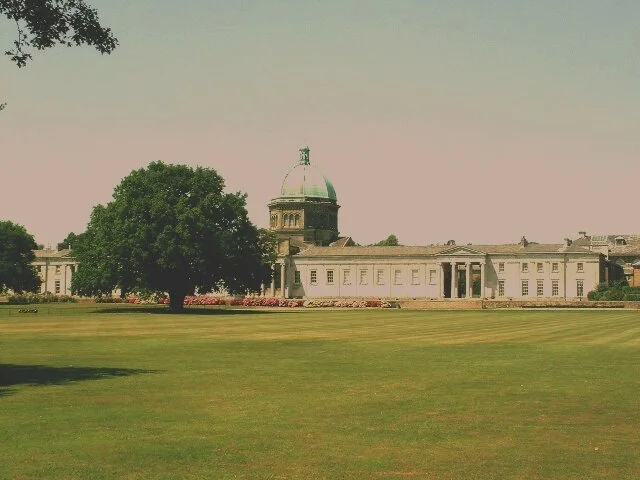
Haileybury and Imperial Service College.
In 1965, Patricia James (1917-1987) drove from her home in Hampstead Garden Suburb up to Haileybury, the old East India College just outside Hertford, where she gave a lecture to the young boys at Melvill House about one of the school’s former teachers, Thomas Robert Malthus, Professor of History and Political Economy there from 1804 to 1834. At the time, she was finishing up her work transcribing and editing a set of manuscripts that had been discovered in 1960, and which eventually were published by Cambridge University Press as The Travel Diaries of T. R. Malthus (1966). As part of this task, she was required to research and write a short biographical sketch that was to accompany the final text; a task which had grown significantly in scope as she discovered just how inaccurate and incomplete the existing accounts of Malthus’ life were. One particularly egregious inaccuracy that she had encountered was found in the introduction to the popular Everyman Edition of Malthus, where the author had called out Malthus’ hypocrisy in having ‘practiced the principle of population to the extent of eleven daughters’; a fact that she easily disproved and - in front of the boys at Haileybury - called out as a ‘scandalous’ departure from the truth by someone who was supposed to be a professor. She quickly realised that she had to start from scratch.
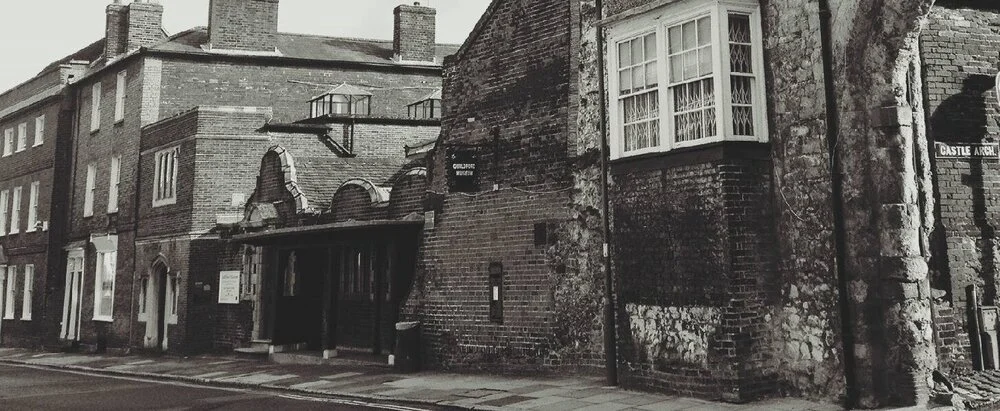
Guildford Museum.
Patricia James was an amateur historian, unaffiliated with any university, but trained as a civil servant and clearly talented for that painstaking and unappreciated work it is to “plod” - as she called it - through one archive after another, meticulously scribbling down every little detail. Through her acquaintance with Lionel (Lord) Robbins (1898-1984) she was able to receive some financial support from the British Academy and the Royal Economic Society, and she used these funds to retrace parts of Malthus’ travels in Scandinavia and visit numerous archives and museums in southern England. At Guilford Museum in Surrey she unearthed the diaries of William Bray and William Man Godschall, both of whom important local gentlemen related to Malthus through marriage, and using unpublished material such as these diaries she began piecing together a much different picture of Malthus, revealing a man who was more multifaceted and much more sympathetic than his malign(ed) reputation suggested. It is fair to say that she was not only correcting factual inaccuracies about Malthus, but also correcting the image of a man whom she felt had been badly misunderstood and mistreated, first by his 19th century detractors, and then by his modern commentators, who were more inclined to side with Rousseau and the revolutionary utopians. As is evident from her speaking-paper, which is published and transcribed below, she was not afraid to admit that she personally hated Rousseau (the man who abandoned his children) and that part of her scholarly motivation derived from a strong conviction that Malthus had been wronged for being, essentially, right. She was thus pleased to note that the spectre of overpopulation was now on many people’s minds again. It had even been on the Queen’s mind in her Christmas broadcast of 1963. As she informed the boys: “… she mentioned overpopulation as one of humanity’s most urgent problems - I was in our kitchen when I heard her, and I cheered and waved my wooden spoon - 170 years after the publication of his book, Malthus has at last become respectable.” (see below, p. 17.).
The biographical sketch that she finished in 1965, and which she delivered at Haileybury in a didactic, child-friendly version, eventually grew larger and larger and after a period of two decades it had turned into a 500-page biography entitled Population Malthus - His Life and Times (1979), which still holds rank today as the definitive account of the life of T. R. Malthus. And for as long as biography is considered essential to a proper understanding of the history of economic thought, so long will students of Malthus be indebted to the impressive detective work of Patricia James. The Institute of Intellectual History is pleased to possess her many papers and notebooks, the legacy of innumerable hours of archival plodding. We shouldn’t be stumped for facts anytime soon.
- L. Andersen
-
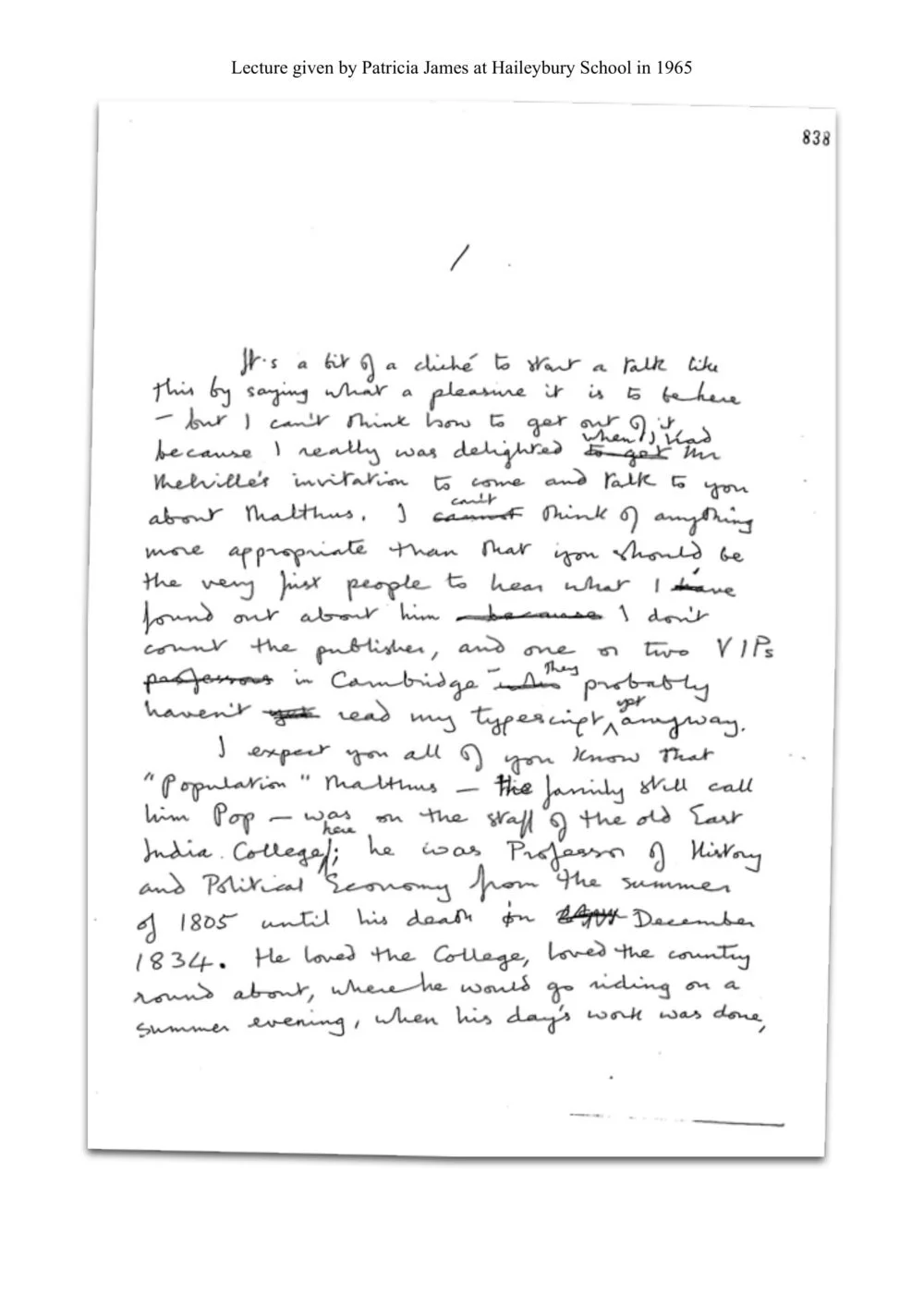
Description text [ ] = crossed out text
<?> = illegible text
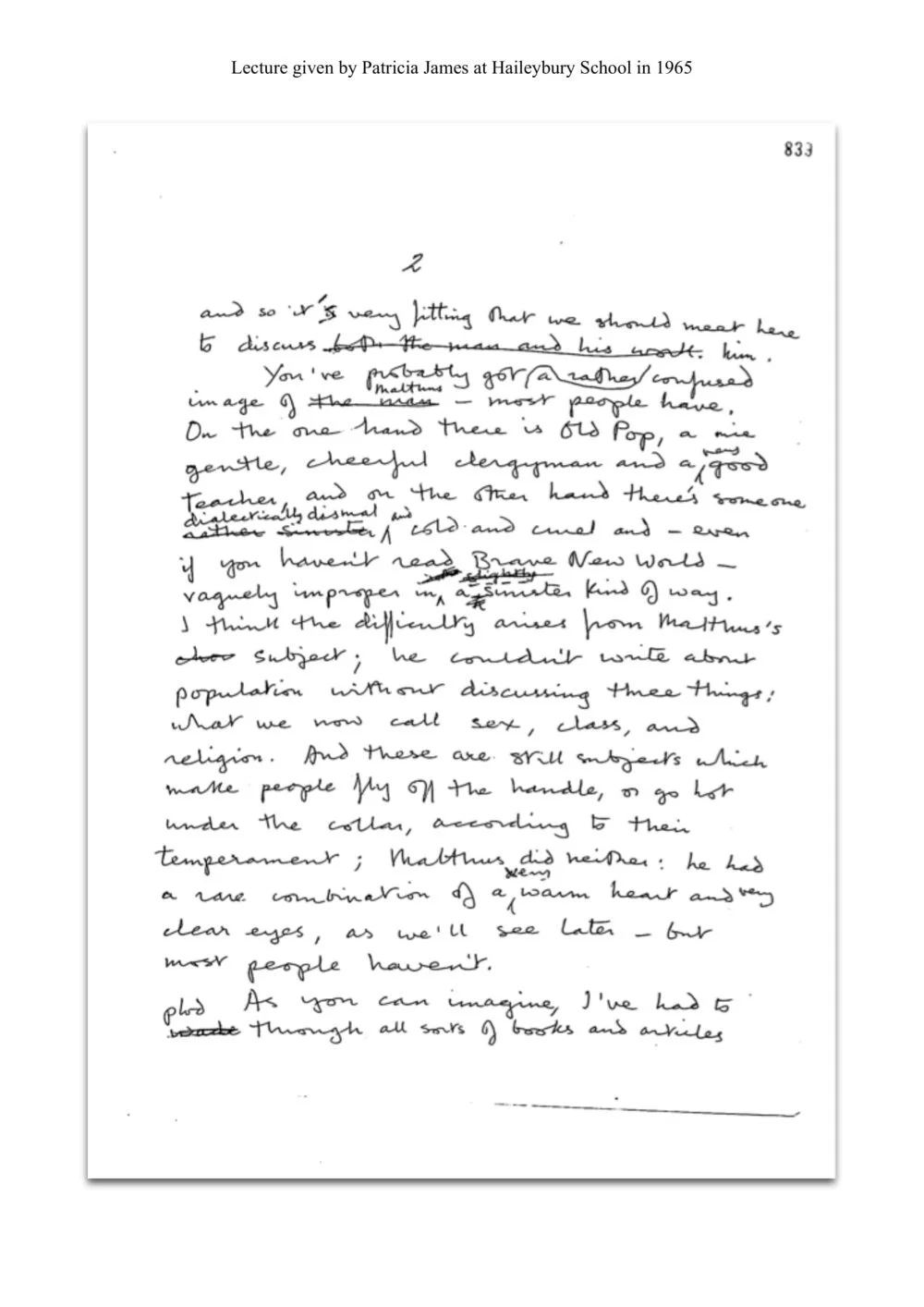
<1> It is is a bit of a cliché to start a talk like this by saying what a pleasure it is to be here - but I can’t think how to get out of it, because I really was delighted when I had Melville’s invitation to come and talk to you about Malthus. I can’t think of anything more appropriate than that you should be the very first people to hear what I found out about him - I don’t count the publishers, and one or two VIPs in Cambridge - they probably haven’t read my typescript yet anyway.
I expect you all of you know that “population” Malthus - the family still call him Pop - was on the staff of the old East India College; he was Professor of history and Political Economy from the summer of 1805 until his death in December 1834. He lived the college, loved the country <?> about, where he would go riding on a summer evening, when his days work was done, <2> and so it is very fitting that we should meet here to discuss [both the man and his work] him. You’ve probably got a rather confused image of [the man] Malthus - most people have. On the one hand there is Old Pop, a nice gentle, cheerful clergyman and a <?> good teacher, and on the other hand there’s someone dialectically dismal and cold and cruel and - even if you haven’t read Brave New World - vaguely improper in a sinister kind of way. I think the difficulty arises from Malthus’s subject; he couldn’t write about population without discussing three things: what we now call sex, class, and religion. And these are still subjects which make people fly off the handle, or go hot under the collar, according to their temperament; Malthus did neither: he had a rare combination of a <?> warm heart and clear eyes, as we’ll see later - but most people haven’t.
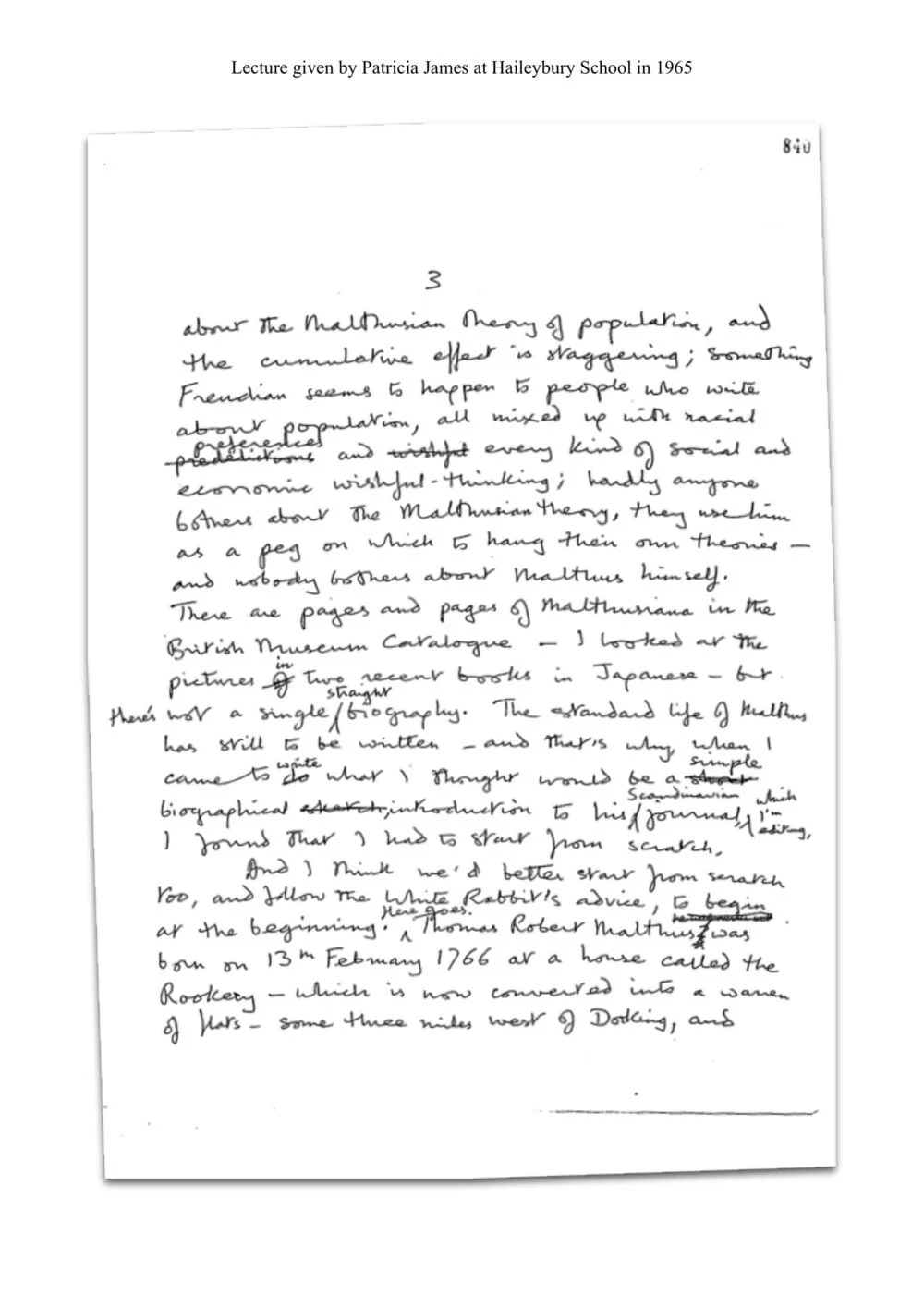
As you can imagine, I’ve had to [wade] plod through all sorts of books and articles <3> about the Malthusian theory of population, and the cumulative effect is staggering; something Freudian seems to happen to people who write about population, all mixed up with racial [predilections] preferences and [wishful] every kind of social and economic wishful thinking; hardly anyone bothers about the Malthusian theory, they use him as a peg on which to hang their own theories - and nobody bothers about Malthus himself. There are pages and pages of Malthusiana in the British Museum Catalogue - I looked at the pictures in two recent books in Japanese - but there’s not a single straight biography. The standard life of Malthus has still to be written - and that’s why when I came to write what I thought would be a simple biographical [sketch] introduction to his Scandinavian journal, which I’m editing, I found that I had to start from scratch.
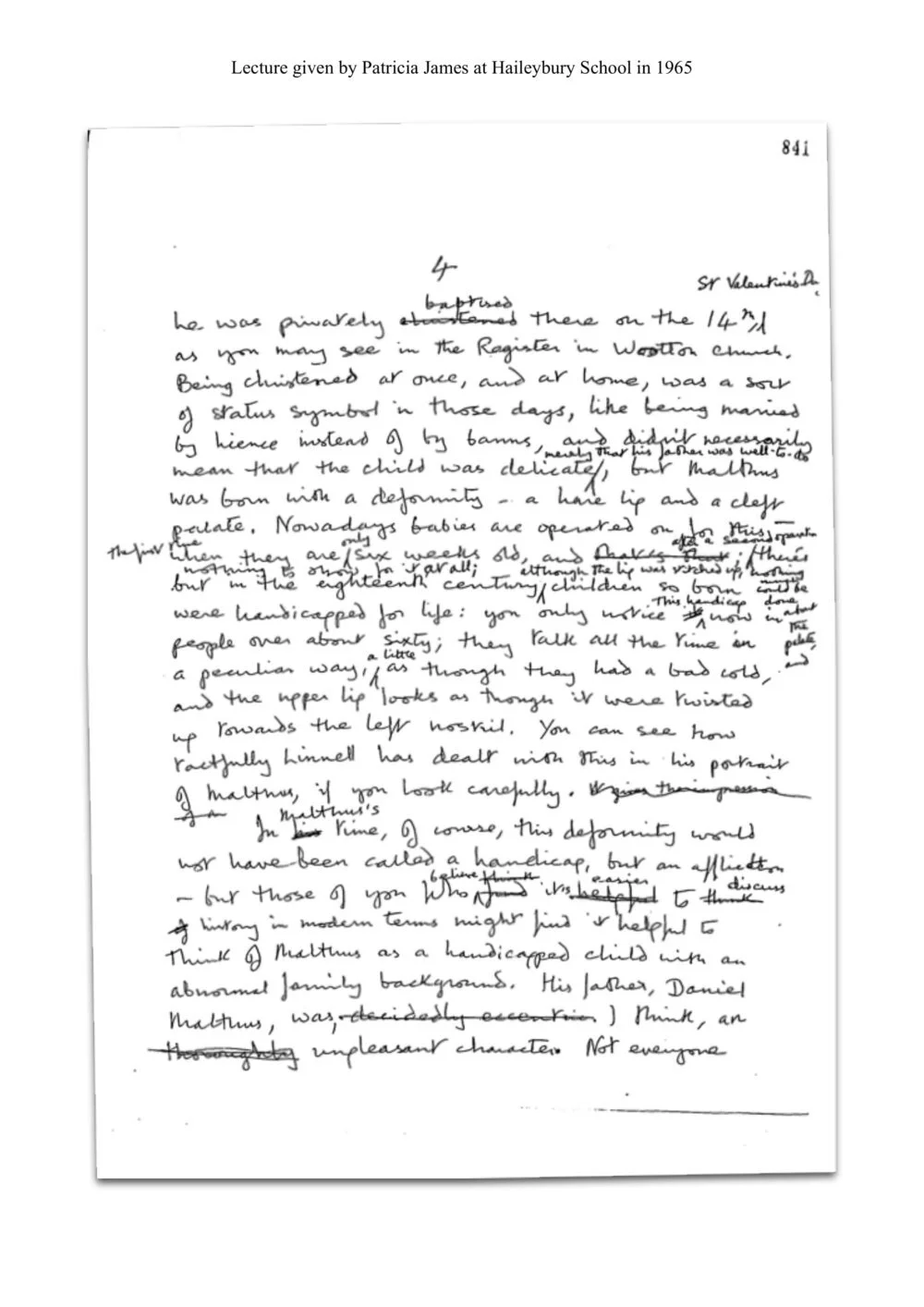
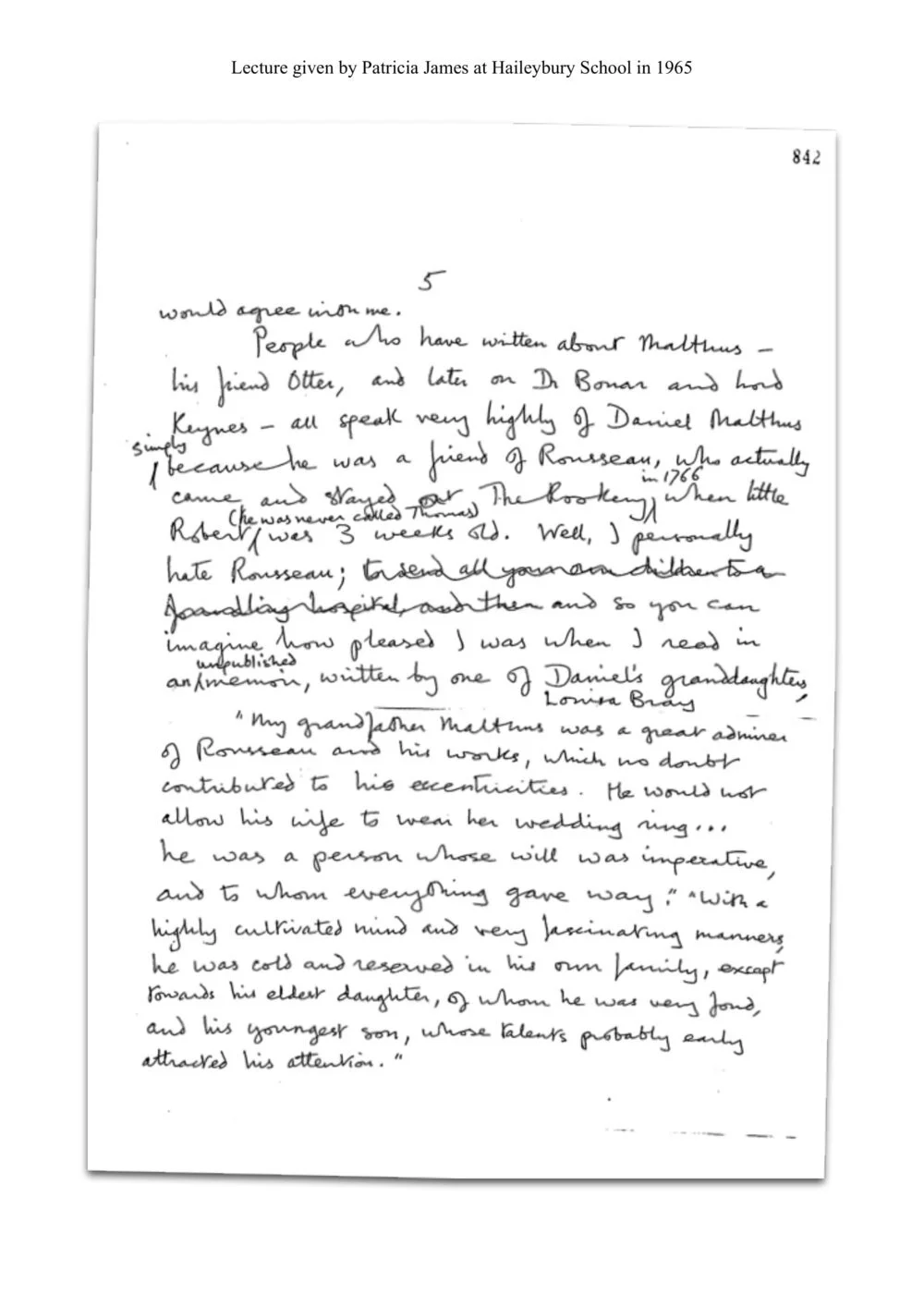
And I think we better start from scratch too, and follow the White Rabbit’s advice, to begin at the beginning. Here goes. Thomas Robert Malthus was born on 13th February 1766 at a house called the Rookery - which is now converted into a warren of flats - some three miles west of Dorking, and <4> he was privately baptised there on the 14th, St Valentine’s day, as you may see in the Register in Wotton Church. Being christened at once, and at home, was a sort of status symbol in those days, like being married by license instead of by banns, and didn’t necessarily mean that the child was delicate, merely that his father was well-to-do, but Malthus was born with a deformity - a hare lip and a cleft palate. Nowadays babies are operated on for this, first time when they are only six weeks old and after a second operation there’s nothing to show for it at all; but in the eighteenth century, although the lip was stitched up, nothing much could be done about the palate, and children so born were handicapped for life: you only notice this handicap now in people over about sixty; they talk all the time in a peculiar way, a little as though they had a bad cold, and the upper lip looks as though it were twisted up towards the left nostril. You can see how tactfully Linnell has dealt with this in his portrait of Malthus, if you look carefully. In Malthus’s time, of course, this deformity would not have been called a handicap, but an affliction - but those of you who believe its easier to discuss history in modern terms might find it helpful to think of Malthus as a handicapped child with an abnormal family background. His father, Daniel Malthus, was [decidedly eccentric], I think, an [thoroughly] unpleasant character. Not everyone <5> would agree with me.
People who have written about Malthus - his friend Otter, and later on Dr Bonar and Lord Keynes - all speak very highly of Daniel Malthus simply because he was a friend of Rousseau, who actually came and stayed at The Rookery in 1766, when little Robert (he was never called Thomas) was 3 weeks old. Well, I personally hate Rousseau; [to send all your own children to a <?> hospital, and then] so you can imagine how pleased I was when I read in an unpublished memoir, written by one of Daniel’s granddaughters, Louisa Bray,
“My grandfather Malthus was a great admirer of Rousseau and his works, which no doubt contributed to his eccentricities. He would not allow his wife to wear her wedding ring… he was a person whose will was imperative, and to whom everything gave way.” “With a highly cultivated mind and very fascinating manners, he was cold and reserved in his own family, except towards his eldest daughter, of whom he was very fond, and his youngest son, whose talents probably early attracted his attention.”
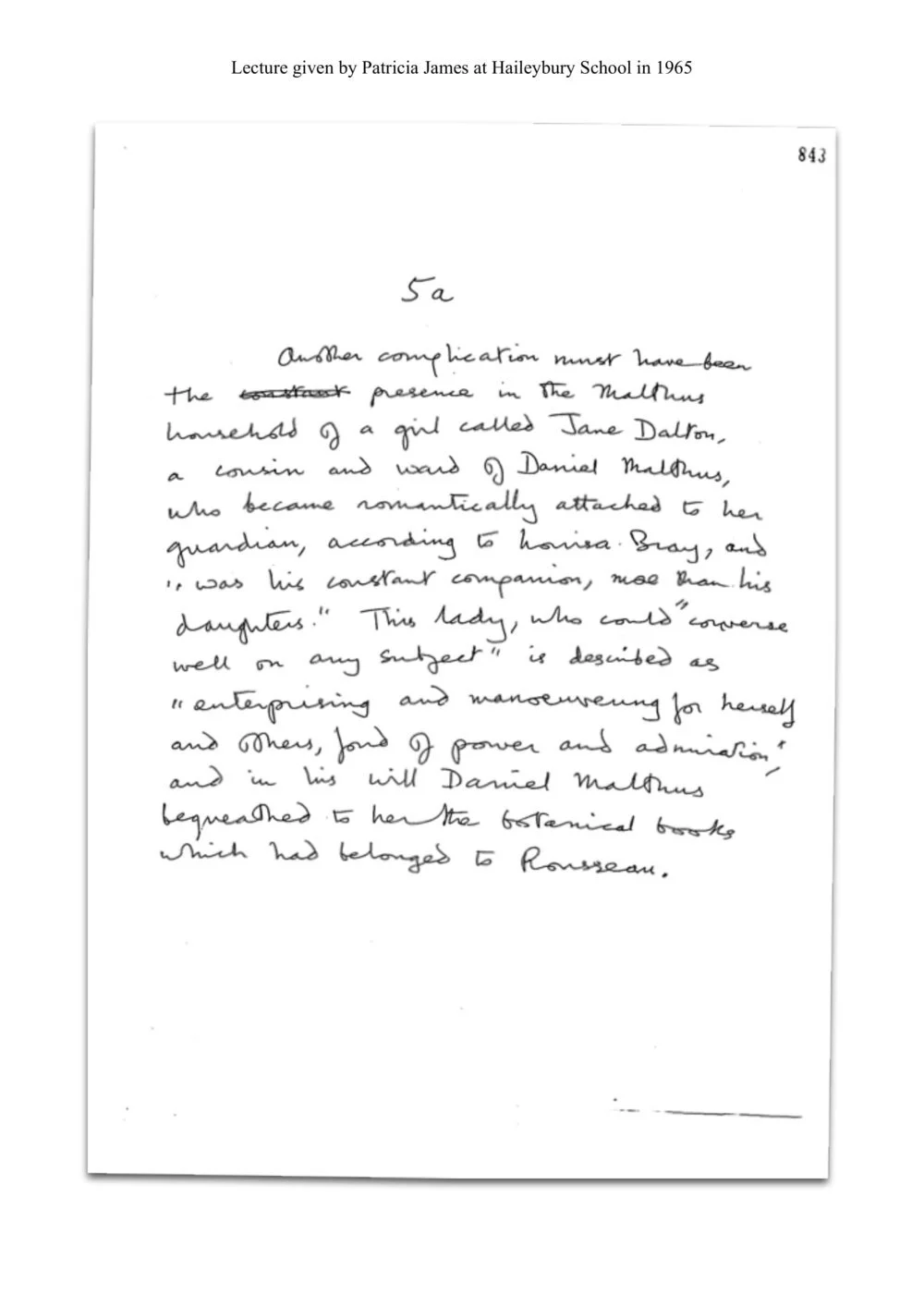
<5a> Another complication must have been the presence in the Malthus household of a girl called Jane Dalton, a cousin and a ward of Daniel matches, who became romantically attached to her guardian, according to Louisa Bray, and “was his constant companion, more than his daughters.” This lady, who could “converse well on any subject” is described as “enterprising and manoeuvring for herself and hers, fond of power and admiration”, and in his will Daniel Malthus bequeathed to her the botanical books which had belonged to Rousseau.
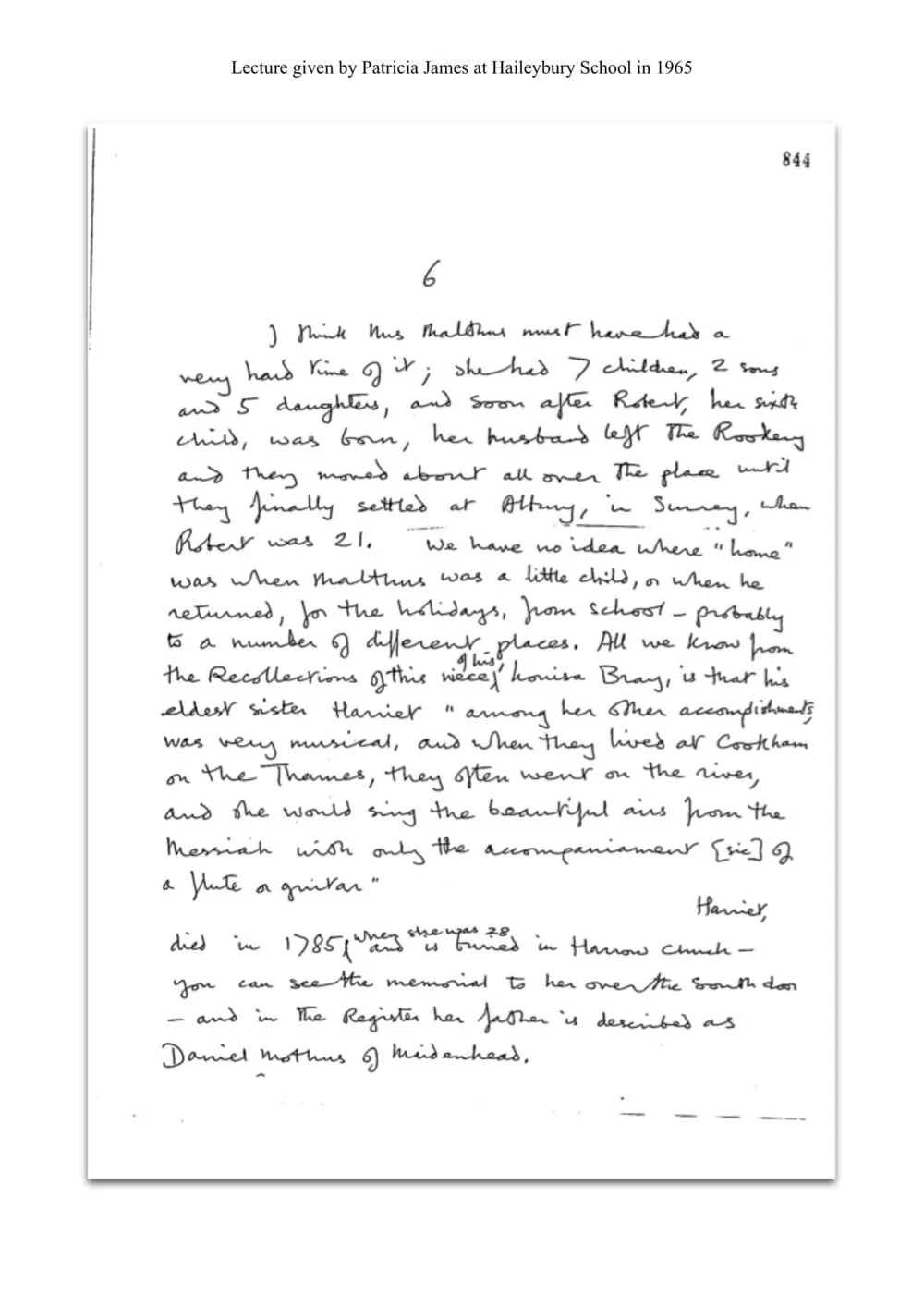
<6> I think Mrs Malthus must have had a very hard time of it; she had 7 children, 2 sons and 5 daughters, and soon after Robert, her sixth child, was born, her husband left The Rookery and they moved about all over the place until they finally settled at Albany, in Surrey, when Robert was 21. We have no idea where “home” was when Malthus was a little child, or when he returned, for the holidays, from school - probably to a number of different places. All we know from the Recollections of this niece of his, Louisa Bray, is that his eldest sister Harriet “among her other accomplishments, was very musical, and when they lived at Cookham on the Thames, they often went on the river, and she would sing the beautiful airs from the Messiah with only the accompaniament (sic) of a flute or guitar”. Harriet died in 1785, when she was 28, and is buried in Harrow Church - you can see the memorial to her over the south door - and in the Register her father is described as Daniel Malthus of Maidenhead.
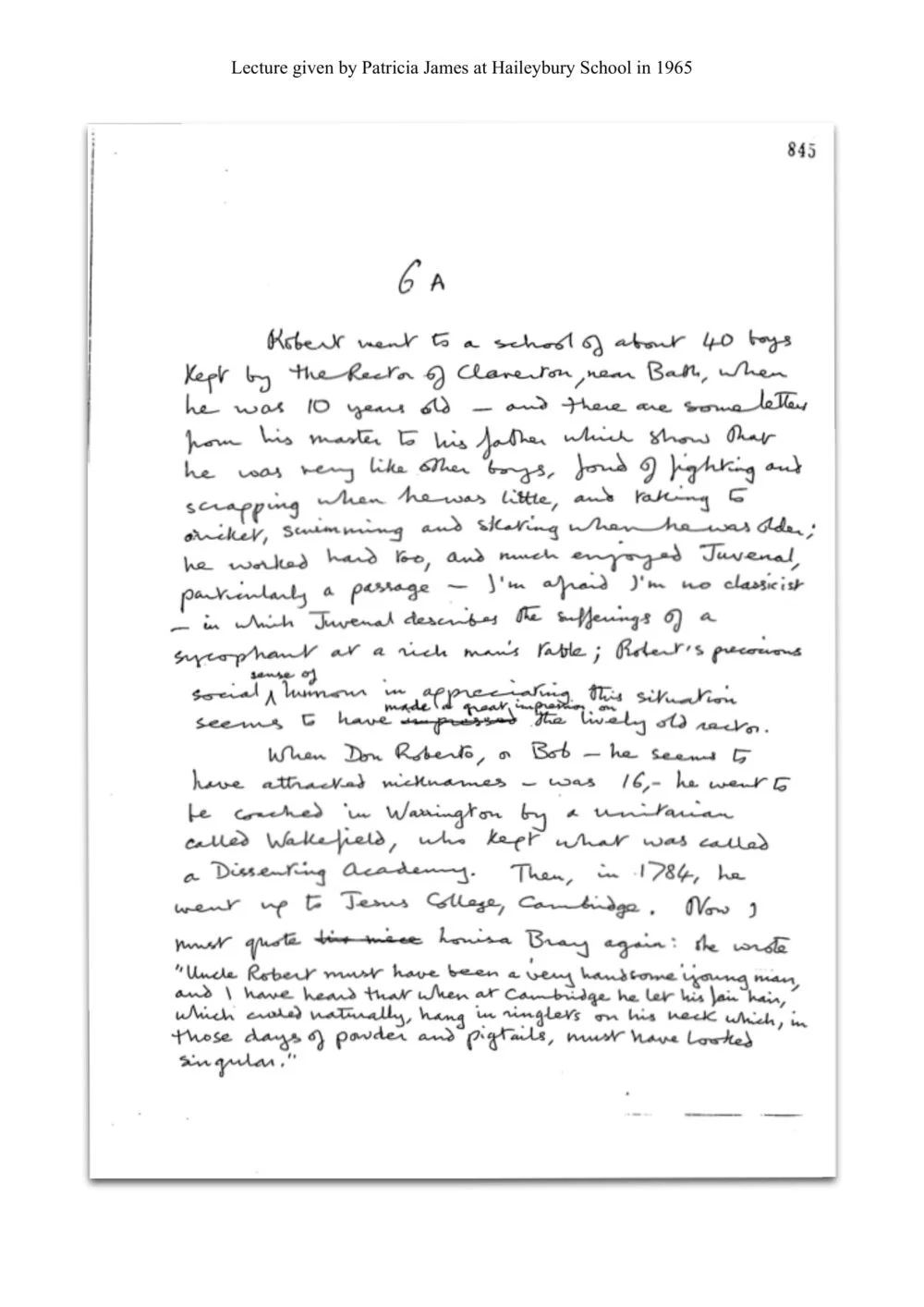
<6a> Robert went to a school of about 40 boys kept by the rector of Clarendon, near Bath, when he was 10 years old - and there are some letters from his master to his father which show that he was very like other boys, fond of fighting and scrapping when he was little, and taking to cricket, swimming and skating when he was older; he worked hard too, and much enjoyed Juvenal, particularly a passage - I’m afraid I’m no classicist - in which Juvenal describes the sufferings of a sycophant at a rich man’s table; Robert’s precocious social sense of <humour?> in appreciating this situation seems to have made great impression on the lively old rector.
When Don Roberto, or Bob - he seems to have attracted nicknames - was 16,- he went to be coached in Warrington by a unitarian called Wakefield, who kept what was called a Dissenting Academy. Then, in 1784, he went up to Jesus College, Cambridge. Now I must quote [his niece] Louisa Bray again: She wrote:
“Uncle Robert must have been a very handsome young man, and I have heard that when at Cambridge he let his fair hair, which curled naturally, hang in ringlets on his neck which, in those days of powder and pigtails, must have looked singular.”
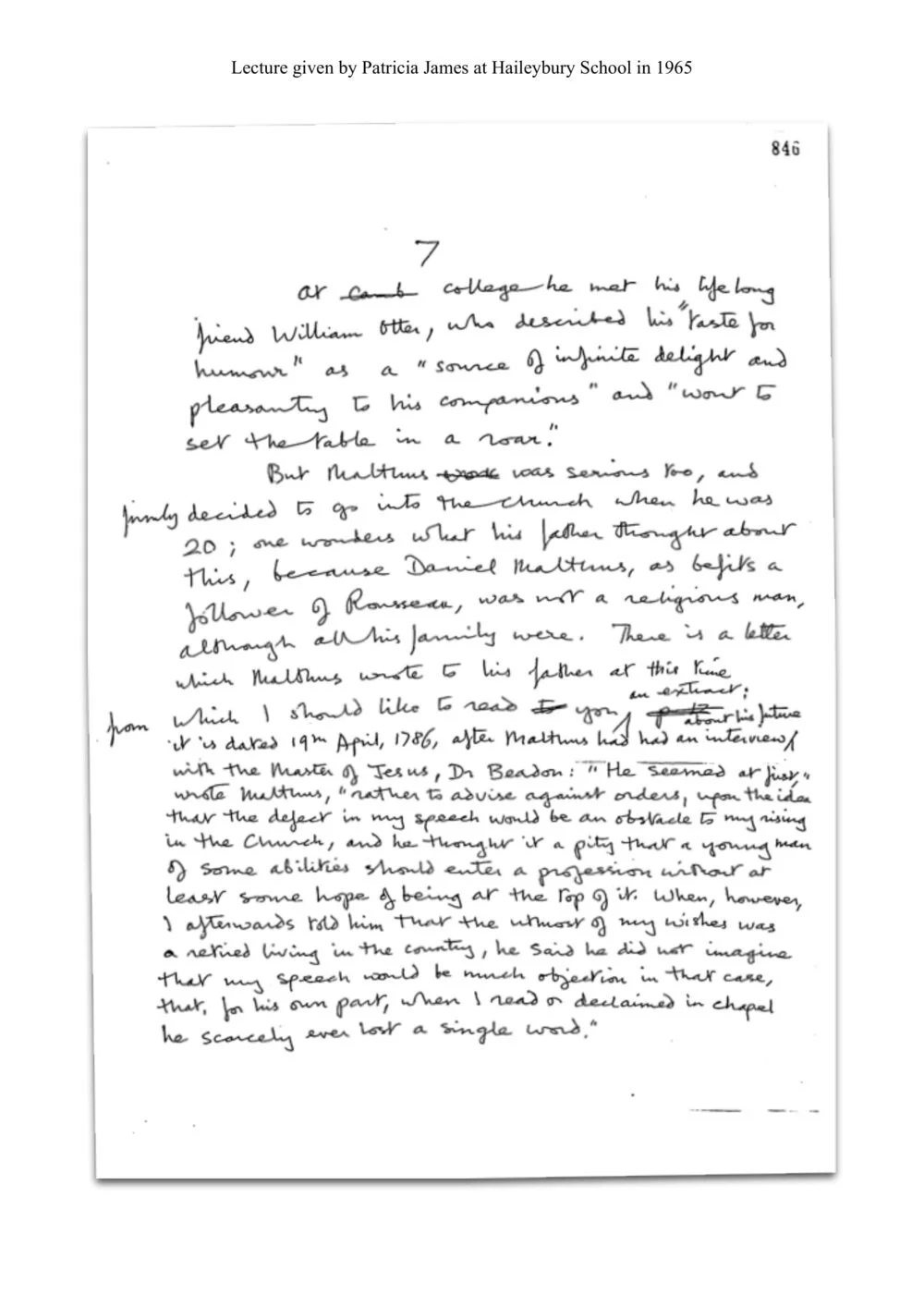
<7> At [Camb] College he met his lifelong friend William Otter, who described his “taste for humour” as a “source of infinite delight and pleasantry to his companions” and “wont to set the table in a roar”. But Malthus [work] was serious too, and firmly decided to go into the church when he was 20; one wonders what his father thought about this, because Daniel Malthus, as befits a follower of Rousseau, was not a religious man, although all his family were. There is a letter which Malthus wrote to his father at this time from which I should like to read you an extract: it is dated 19th April, 1786, after Malthus had had an interview about his future with the master of Jesus, Dr Beadon: “He seemed at first,” wrote Malthus, “rather to advice against orders, upon the idea that the defect in my speech would be an obstacle to my rising in the church, and he thought it a pity that a young man of some ability should enter a profession without at least some hope of being at the top of it. When, however, I afterwards told him that the utmost of my wishes was a retired living in the country, he said he did not imagine that my speech would be much objection in that case, that, for his own part, when I read or declaimed in chapel he scarcely even lost a single word.”
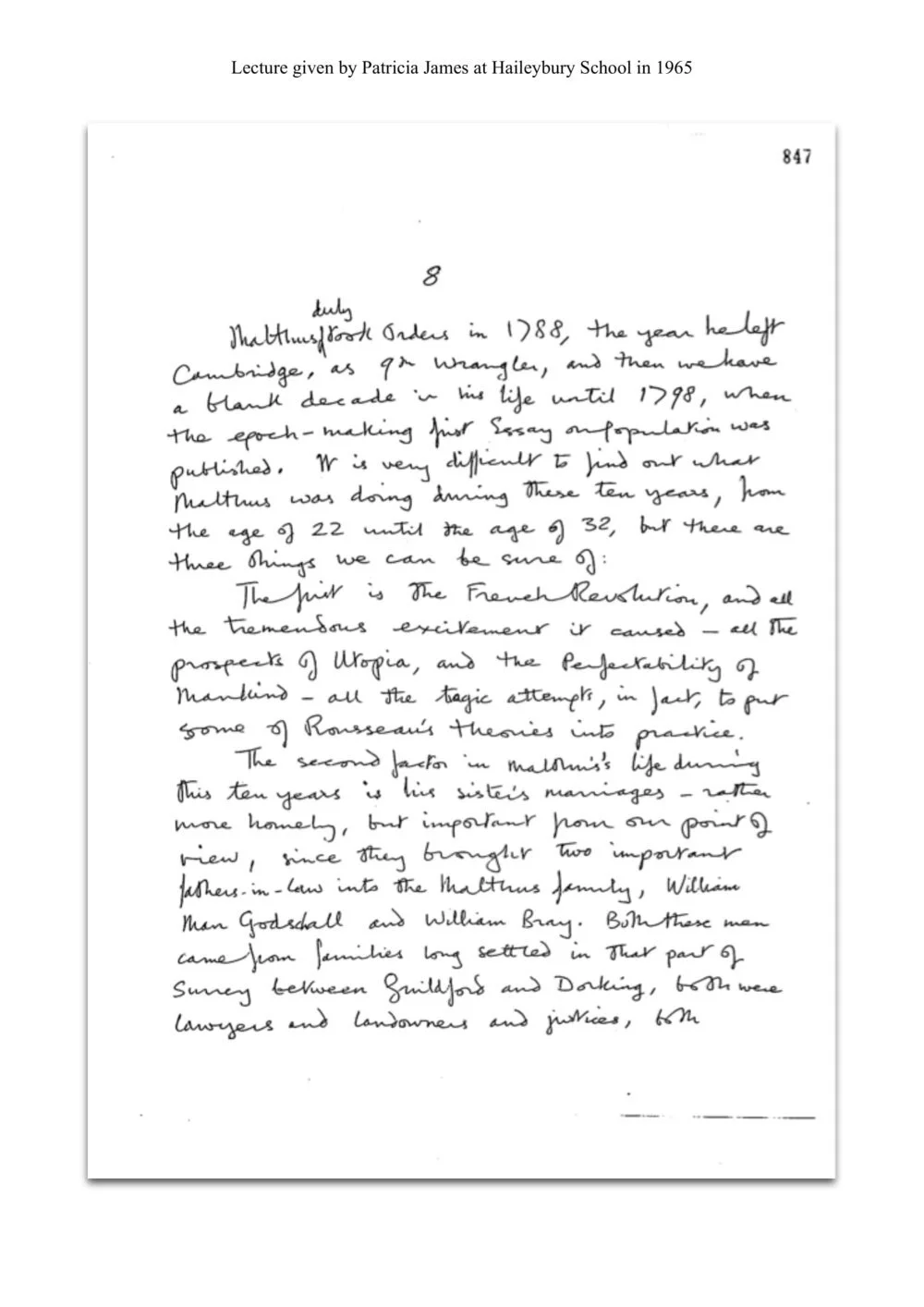
<8> Malthus duly took Orders in 1788, the year he left Cambridge, as 9th wrangler, and then we have a black decade in his life until 1798, when the epoch-making first essay on population was published. It is very difficult to find out what Malthus was doing during these ten years, from the age of 22 until the age of 32, but there are three things we can be sure of:
The first is the French Revolution, and all the tremendous excitement it caused - all the prospects of Utopia, and the perfectibility of mankind - all the tragic attempts, in fact, to put some of Rousseau’s theories into practice.
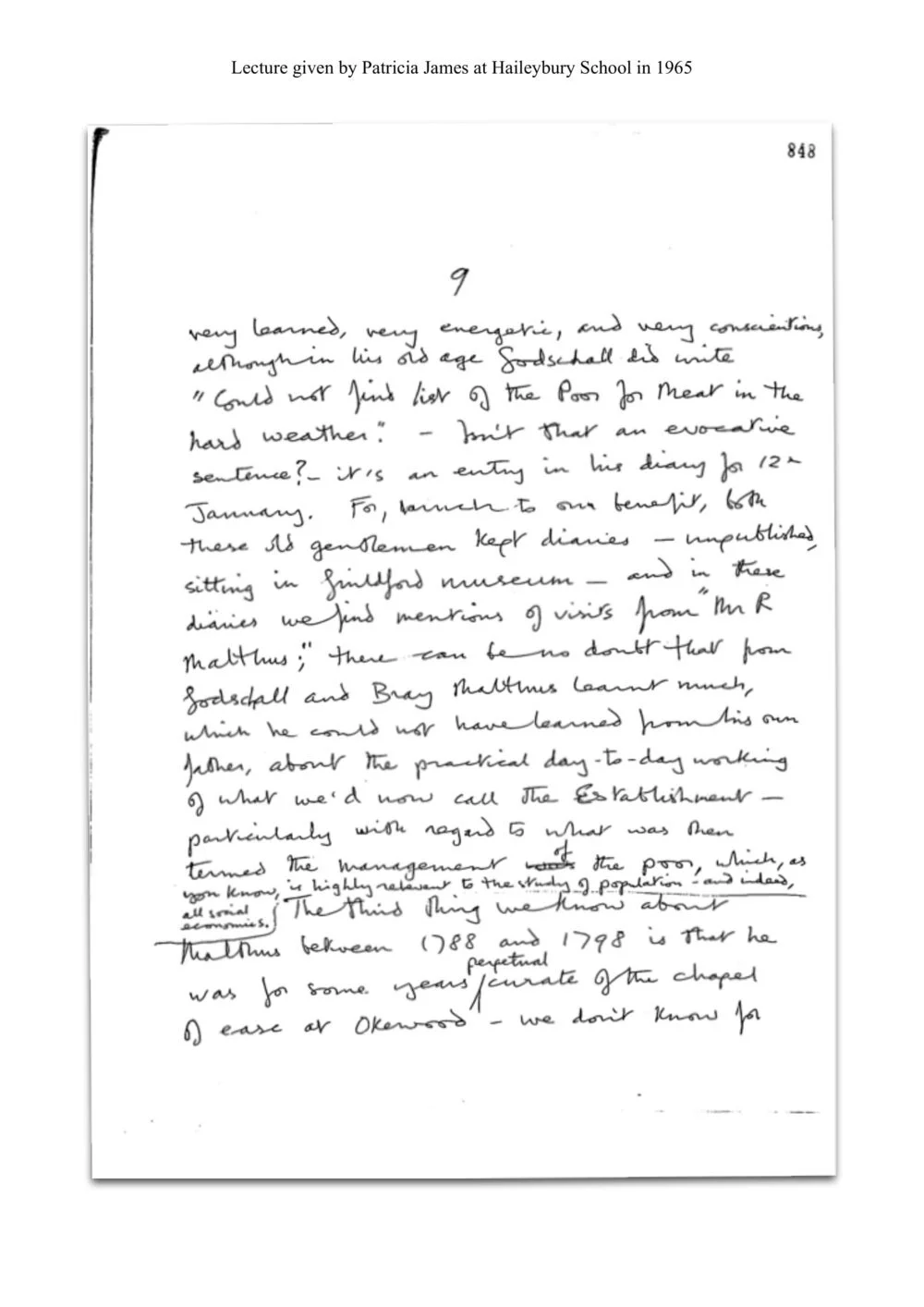
The second factor in Malthus’s life during this ten years is his sisters’ marriages - rather more homely, but important from our point of view, since they brought two important fathers-in-law into the Malthus family, William Man Godschall and William Bray. Both these men came from families long settled in that part of Surrey between Guildford and Dorking, both were lawyers and landowners and justices, both <9> were learned, very energetic, and very conscientious, although in old age Godschall did write “Could not find list of the poor for meat in the hard weather.” Isn’t that an evocative sentence? - It is an entry in his diary for 12th January. For, much to our benefit, both these old gentlemen kept diaries - unpublished, sitting in Guildford museum - and in these diaries we find mentions of visits from “Mr R Malthus;” there can be no doubt that from Godschall and Bray Malthus learned much, which he could not have learned from his own father, about the practical day-to-day working of what we’d now call the Establishment - particularly with regard to what was then termed the management of the poor, which, as you know, is highly relevant to the study of population . And indeed, all social economics.
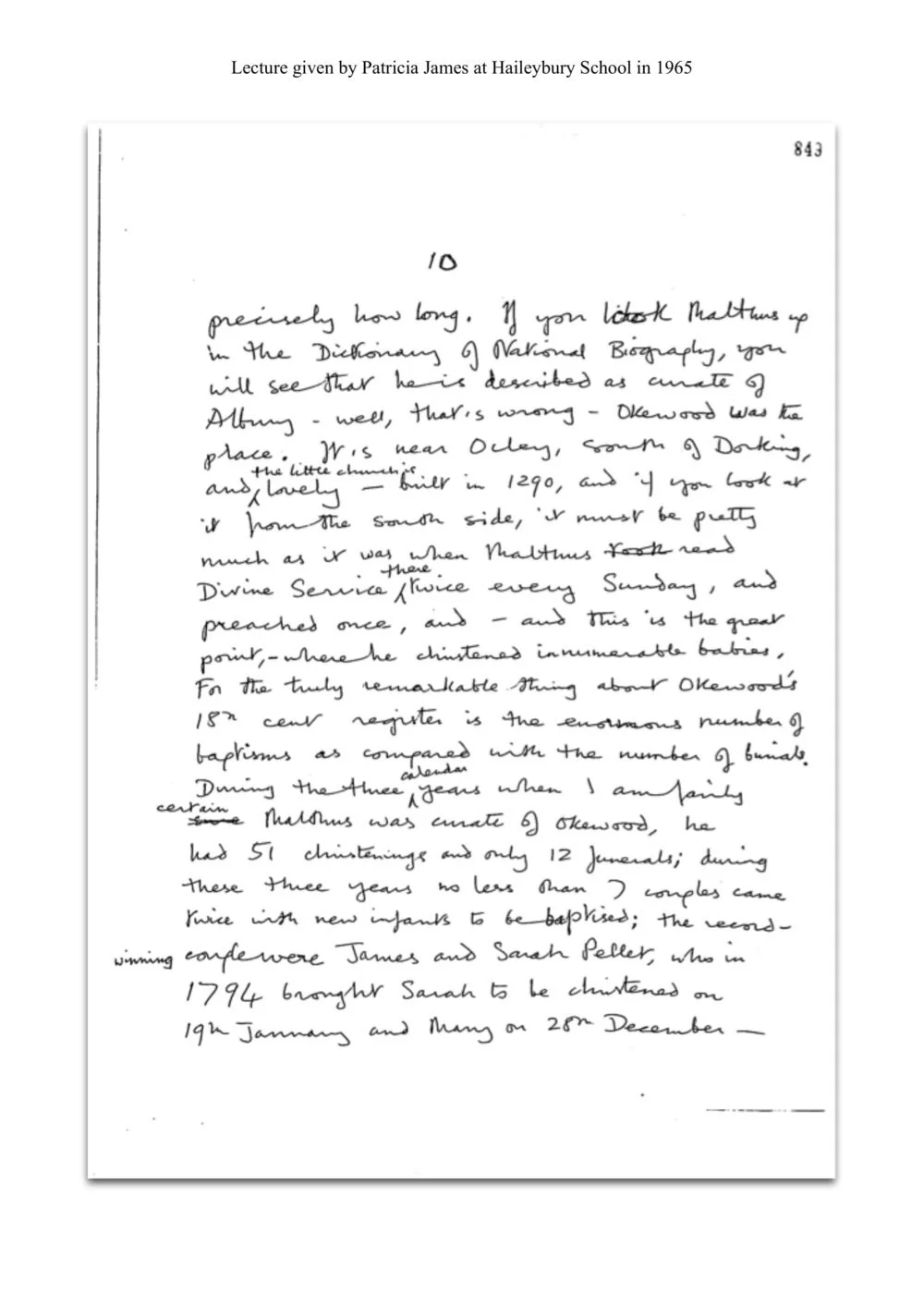
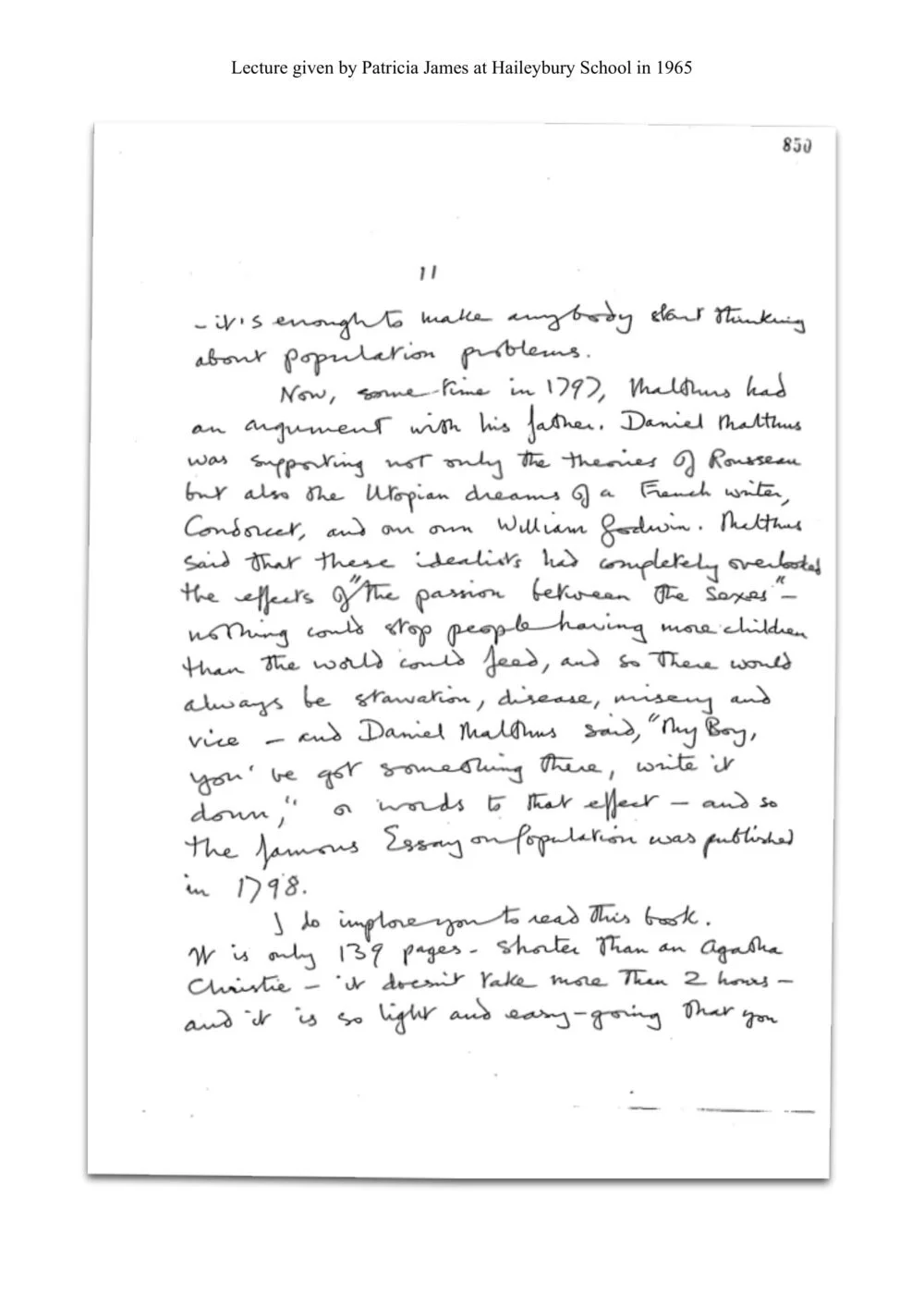
The third thing we know about Malthus between 1788 and 1798 is that he was for some years perpetual curate of the chapel of ease at Okewood - we don’t know for <10> precisely how long. If you look Malthus up in the Dictionary of National Biography, you will see that he is described as curate of Albany - well, that is wrong - Okewood was the place. It is near Oxley, south of Dorking, and the little church is lovely - built in 1290, and if you look at it from the south side, it must be pretty much as it was when Malthus [took] read Devine Service there twice every Sunday, and preached once, and - and this is the great point, - where he christened innumerable babies. For the truly remarkable thing about Okewood’s 18th century register is the enormous number of baptisms as compared with the number of burials. During the three calendar years when I am fairly certain Malthus was curate of Oakwood, he had 51 christenings and only 12 funerals; during these three years no less than 7 couples came twice with new infants to be baptised; the record-winning couple were James and Sarah Pellet, who in 1794 brought Sarah to be Christened who in 1794 brought Sarah to be christened on 10th January and Mary on 28th December - <11> it's enough to make anybody start thinking about population problems.
Now, sometime in 1797, Malthus had an argument with his father. Daniel Malthus was supporting not only the theories of Rousseau but also the utopian dreams fo a French writer, Condorcet, and our own William Godwin. Malthus said that these idealists had completely overlooked the effects of “the passions between the sexes” - nothing could stop people having more children than the world could feed, and so there would always be starvation, disease, misery and vice, - and Daniel Malthus said, “My Boy, you’ve got something there, write it down,” or words to that effect - and so the famous Essay on Population was published in 1798.
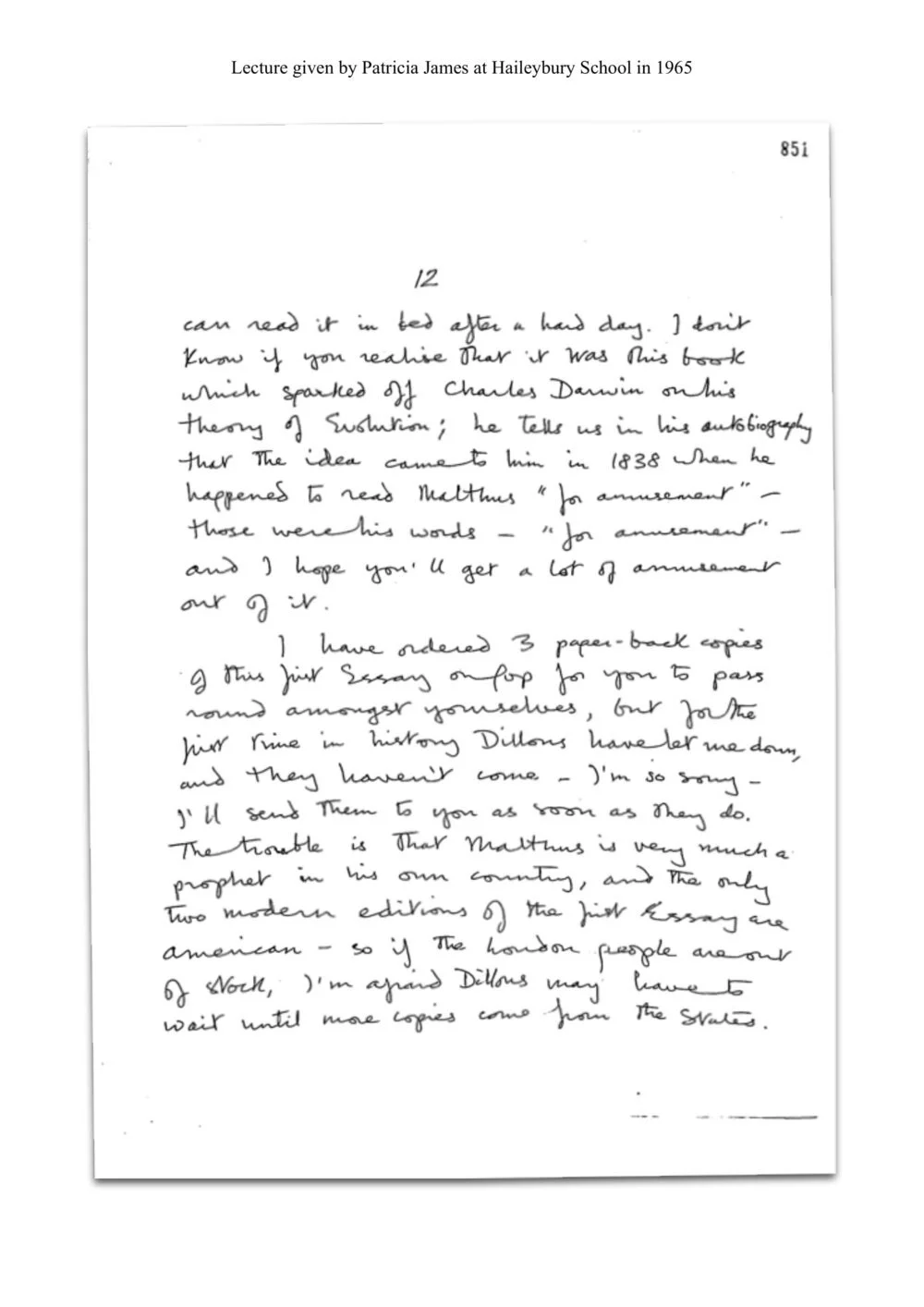
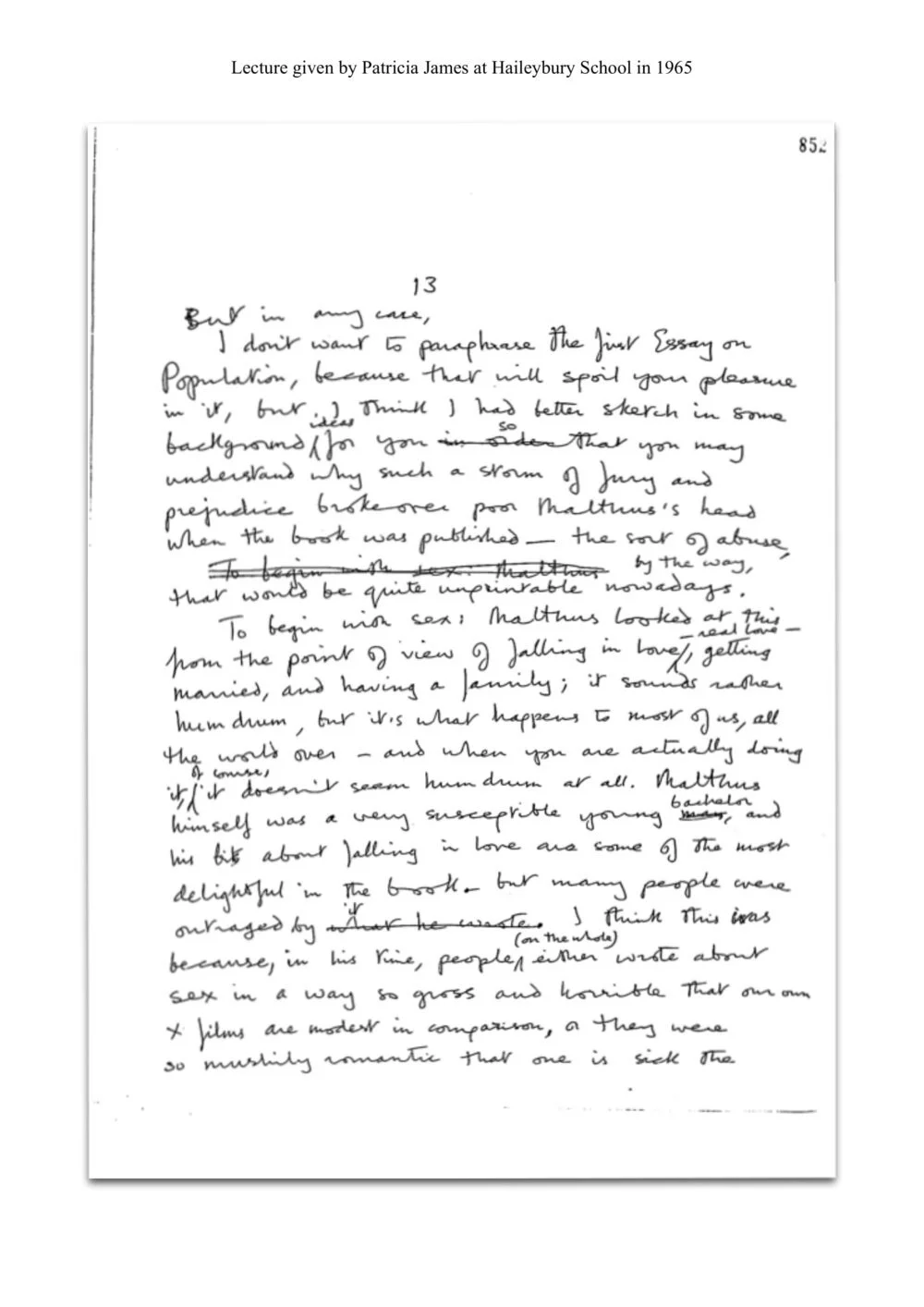
I do implore you to read this book. It is only 139 pages. Shorter than an Agatha Christie - it doesn’t take more than 2 hours - and it is so light and easy-going that you <12> can read it in bed after a hard day. I don’t know if you realise that it was this book which sparked off Charles Darwin on his theory of Evolution; he tells us in his autobiography that the idea came to him in 1838 when he happened to read Malthus “for amusement” - those were his words “for amusement” - and I hope you’ll get a lot of amusement out of it. I have ordered 3 paper-back copies of this first Essay on Pop for you to pass around amongst yourselves, but for the first time in history Dillons have let me down, and they haven’t come - I’m so sorry - I’ll send them to you as soon as they do. The trouble is that Malthus is very much a prophet in his own country, and the only two modern editions of the first Essay are American - so if the London people are out of stock, I’m afraid Dillons may have to wait until more copies come from the States. <13> But in any case, I don’t want to paraphrase the first Essay on Population, because that will spoil your pleasure in it, but I think I had better sketch in some background ideas for you [in order] so that you may understand why such a storm of fury and prejudice broke over poor Malthus’s head when the book was published - the sort of abuse, by the way, that would be quite unprintable nowadays.
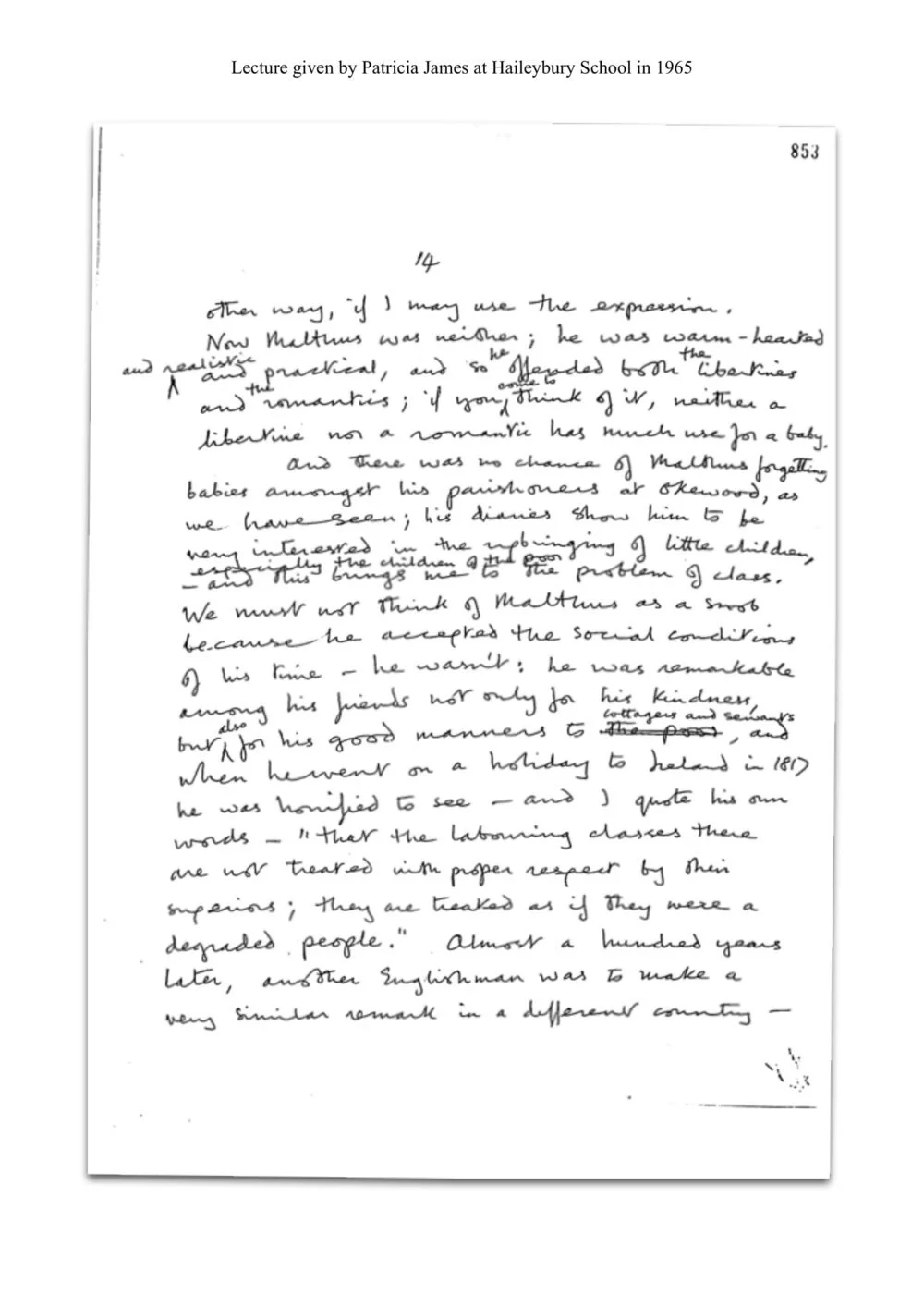
To begin with sex: Malthus looked at this from the point of view of falling in love, real love, getting married, and having a family; it sounds rather humdrum, but it is what happens to most of us, all the world over - and when you are actually doing it, it doesn’t seem humdrum at all. Malthus himself was a very susceptible young bachelor, and his bit about falling in love are some of the most delightful in the book, but many people were outraged by [what he wrote] it. I think this was because, in his time, people on the whole either wrote about sex in a way so gross and horrible that our own x films are modest in comparison, or they were so <?> romantic that one is sick the <14> other way, if I may use the expression. Now Malthus was neither; he was warm-hearted and realistic and practical, and so he offended both the libertines and the romantics; if you come to think of it, neither a libertine nor a romantic has much use for a baby.
And there was no chance of Malthus forgetting babies amongst his parishioners at Okewood, as we have seen; his diaries show him to be very interested in the upbringing of little children, especially the children of the poor - and this brings me to the problem of class.
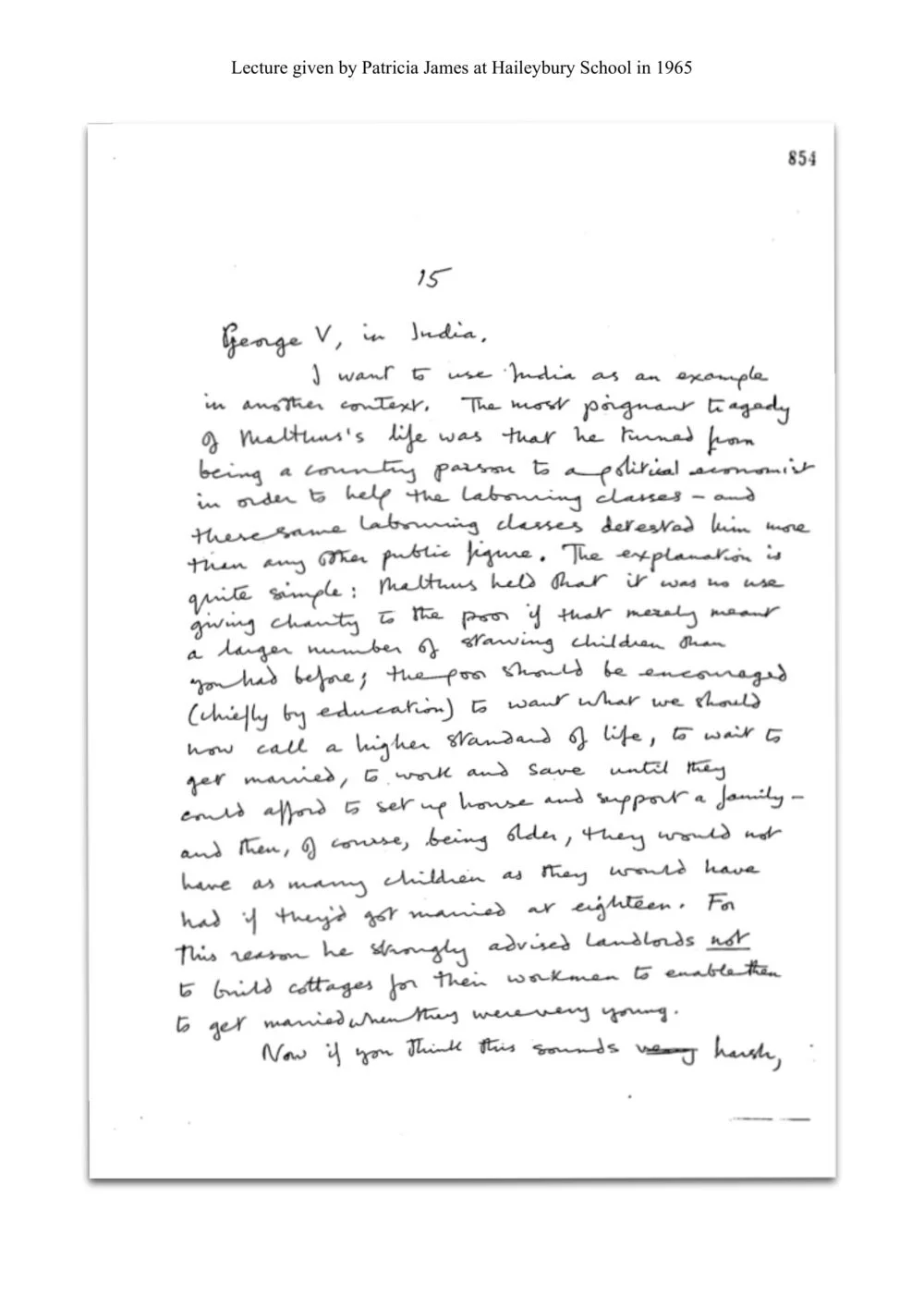
We must not think of Malthus as a snob because he accepted the social conditions of his time - he wasn’t: he was remarkable among his friends not only for his kindness, but also for his good manners to cottagers and servants, and when he went on a holiday to Ireland in 1817 he was horrified to see - and I quote his own words - “that the labouring classes there are not treated with proper respect by their superiors; they are treated as if they were a degraded people.” Almost a hundred years later, another Englishman was to make a very similar remark in a different country - <15> George V, in India.
I want to use India as an example in another context. The most poignant tragedy of Malthus’s life was that he turned from being a country parson to a political economist in order to help the labouring classes - and these same labouring classes detested him more than any other public figure. The explanation is quite simple: Malthus held that it was no use giving charity to the poor if the merely meant a larger number of starving children than you had before; the poor should be encouraged (chiefly by education) to want what we should now call a higher standard of life, to wait to get married, to work and save until they could afford to set up house and support a family - and then, of course, being older, they would not have as many as they would have had if they’d got married at eighteen. For this reason he strongly advised landlords not to build cottages for their workmen to enable them to get married when they were very young.
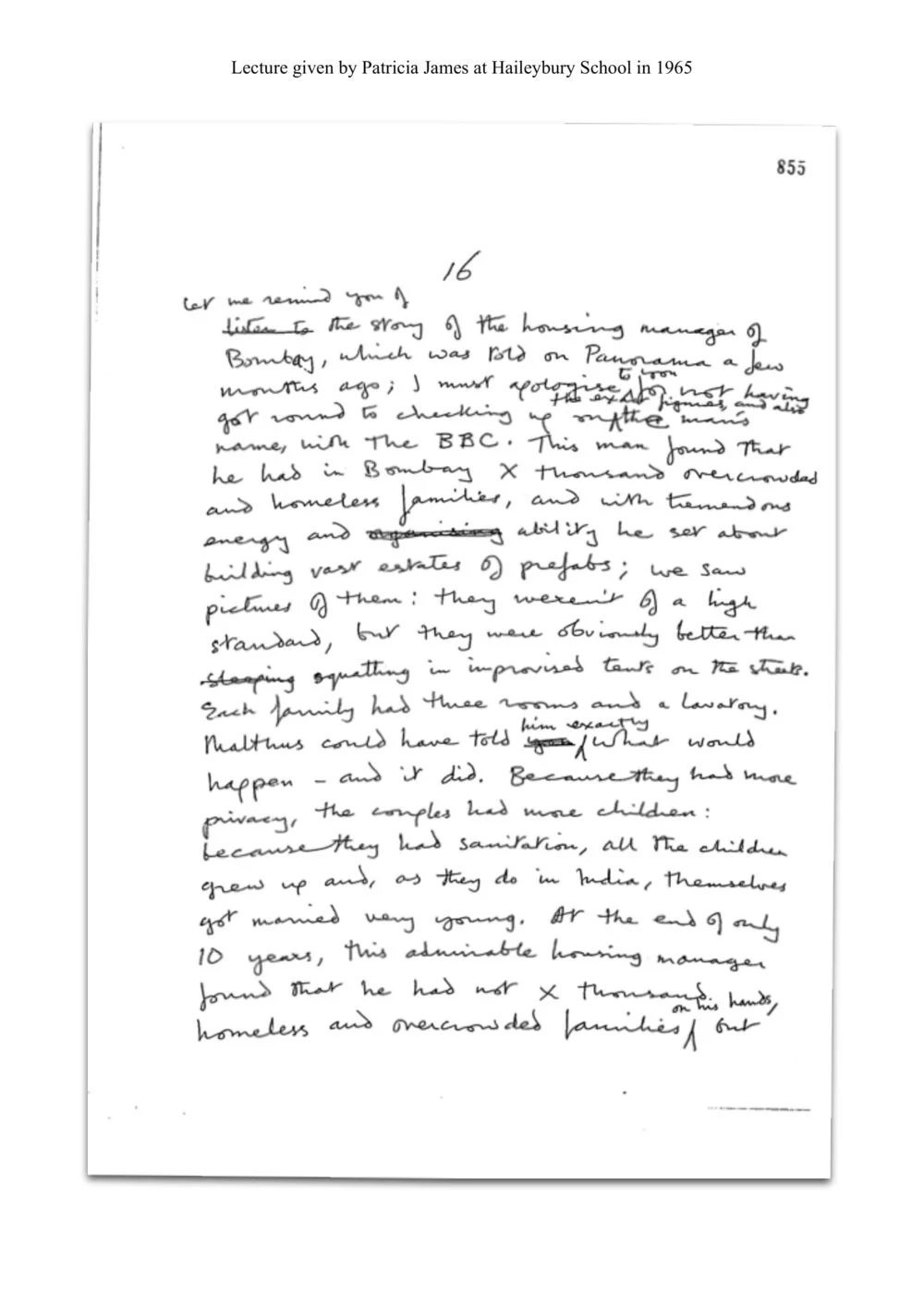
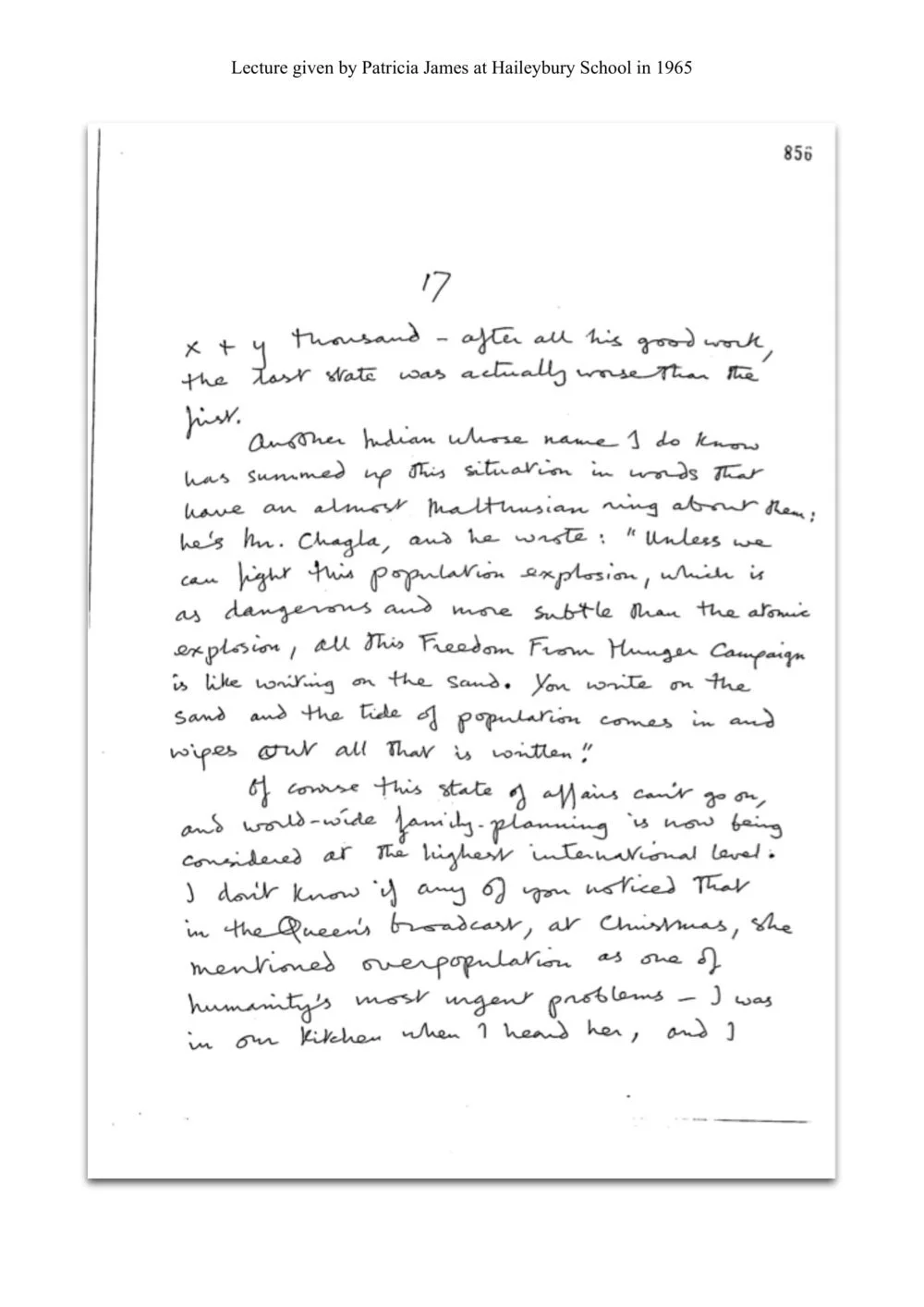
Now if you think this sounds very harsh, <16> let me remind you of [listen to] the story of the housing manager of Bombay, which was told on Panorama a few months ago; I must apologise to you for not having the exact figures, and also got got round to checking up on the man’s name, with the BBC. This man found that he had in Bombay X thousand overcrowded and homeless families, and with tremendous energy and organising ability he set about building vat estates of prefabs; we sae pictures of them: they weren’t of a high standard, but they were obviously better than sleeping squatting in improvised tents on the <?>. Each family had three rooms and a lavatory. Malthus could have told [you] him exactly what would happen, and it did. Because they had more privacy, the couples had more children: because they had sanitation, all the children grew up, as they do in India, themselves got married very young. At the end of only 10 years, this admirable housing manager found that he had not X thousand homeless and overcrowded families on his hands, but <17> X + Y thousand - after all his good work, the last state was actually worse than the first.
Another Indian whose name I do know has summed up this situation in words that have an almost Malthusian ring about them: he’s Mr. Chagla, and he wrote: “Unless we can fight this population explosion, all this Freedom From Hunger Campaign is like writing on the sand and the tide of population comes in and wipes out all that is written.”
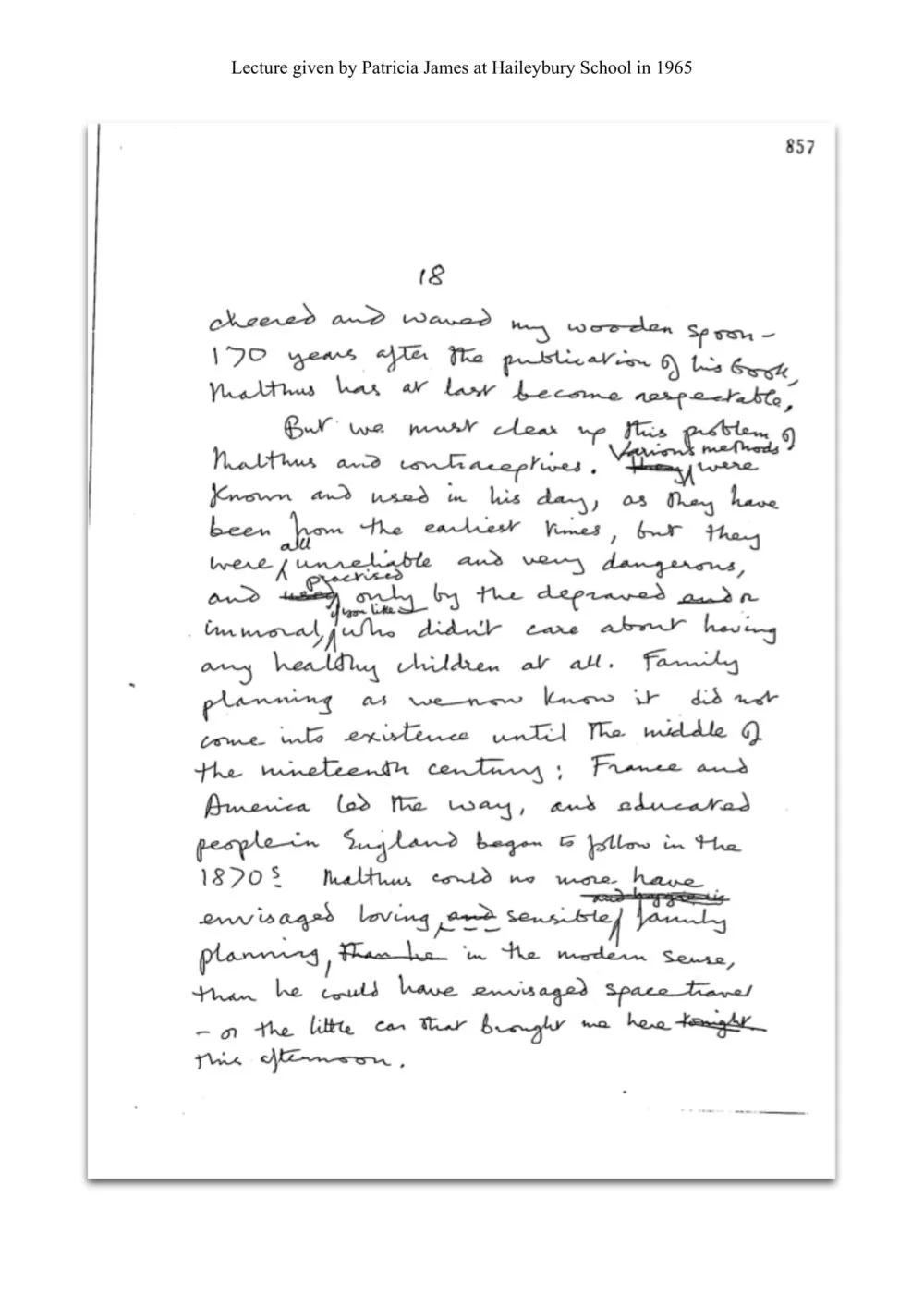
Of course this state of affairs can’t go on, and world-wide family-planning is now being considered at the highest international level. I don’t know if any of you noticed that in the Queen’s broadcast, at Christmas, she mentioned overpopulation as one of humanity’s most urgent problems - I was in our kitchen when I heard her, and I <18> cheered and waved my wooden spoon - 170 years after the publication of his book, Malthus has at last become respectable.
But we must clear up this problem of Malthus and contraceptives. Various methods were known and used in his day, as they have been from the earliest times, but they were all unreliable and very dangerous, and practiced only by the depraved and or immoral, if you like, who didn’t care about having any healthy children at all. Family planning as we now know it did not come into existence until the middle of the nineteenth century: France and America led the way, and educated people in England began to follow in the 1870s. Malthus could no more have envisaged loving and sensible family planning, [than he] in the modern sense, than he could have envisaged space travel - or the little car that brought me here this afternoon. <19>
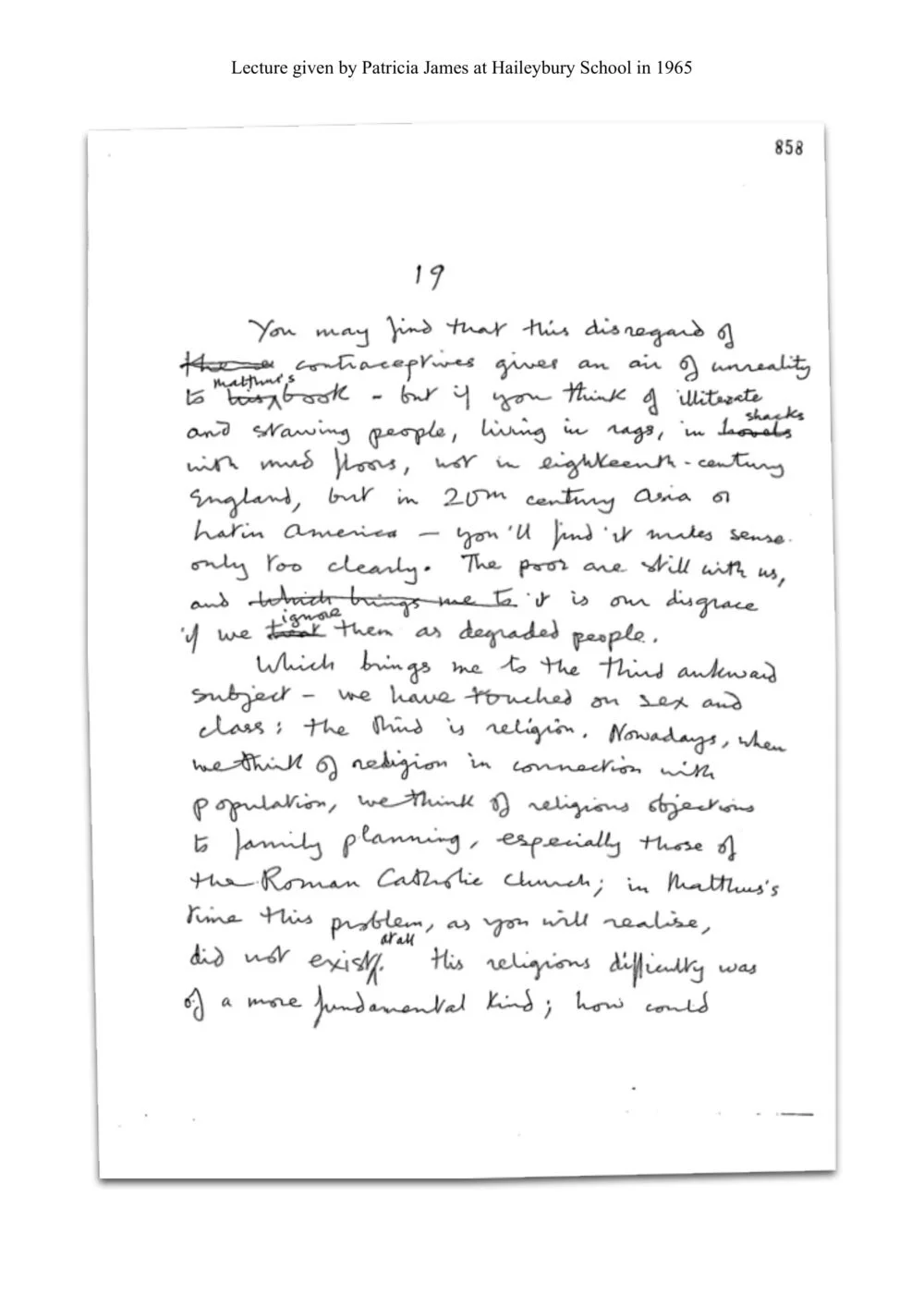
You might find that this disregard of [the] contraceptives gives an air of unreality to Malthus’s book - but if you think of illiterate and starving people, living in rags, in [hovels] shacks with mud floors, not in eighteenth-century England but in 20th century Asia or Latin America - you’ll find it makes sense only too clearly. The poor are still with us, and [which brings me to] it is our disgrace if we ignore them as degraded people.
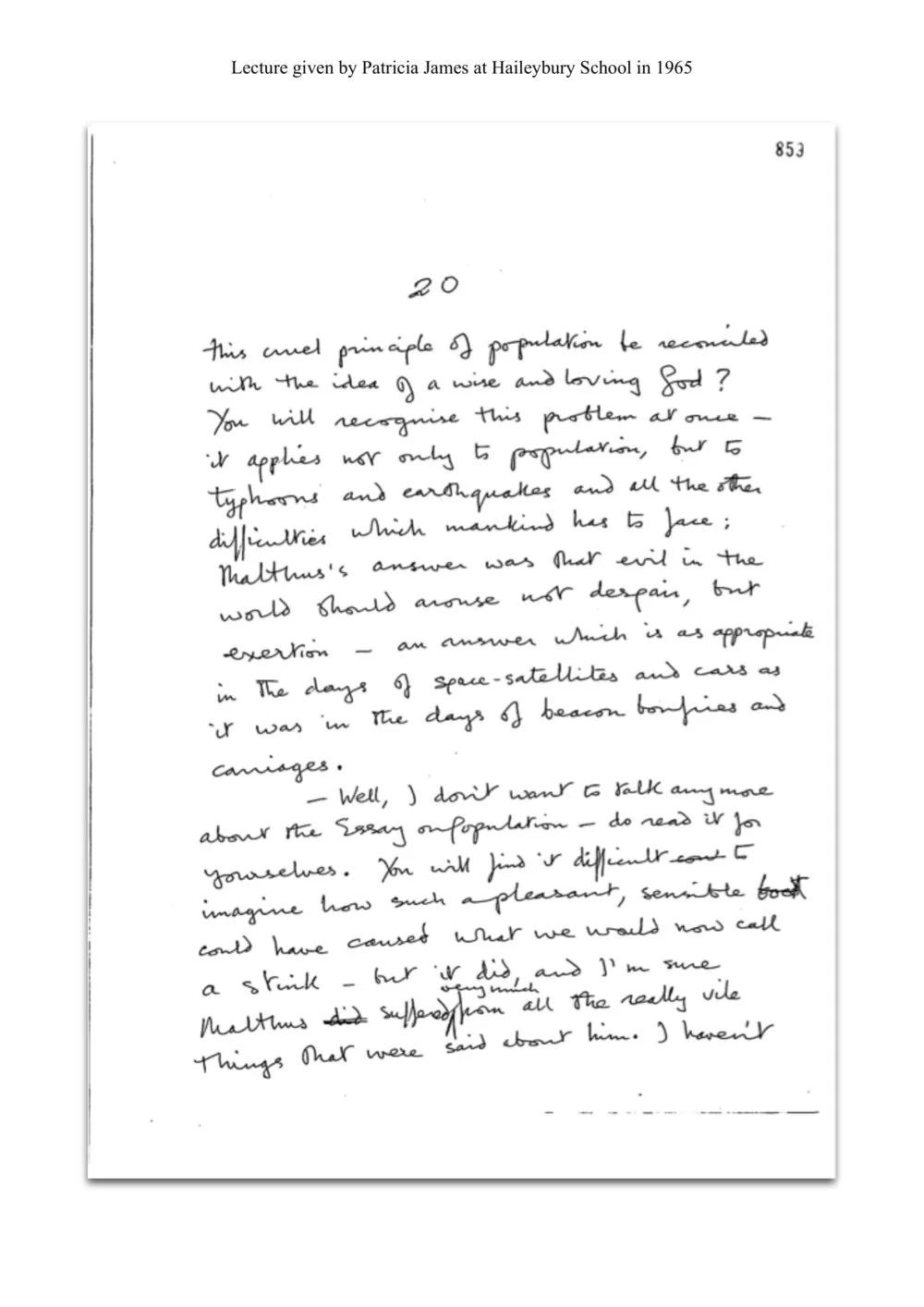
Which brings me to the third awkward subject - we have touched on sex and class: the third is religion. Nowadays, when we think of religion in connection with population, we think of religious objections to family planning, especially those of the Roman Catholic Church; in Malthus’s time this problem, as you will realise, did not exists at all. His religious difficulty was of a more fundamental kind; how could <20> this cruel principle of population be reconciled with the idea of a wise and loving God? You will recognise this problem at once - it applies not only to population, but to typhoons and earthquakes and all the other difficulties which mankind has to face: Malthus’s answer was that evil in the world should arouse not despair, but exertion - an answer which is as appropriate in the days of space-satellites and cars as it was in the days of beacon bonfires and carriages.
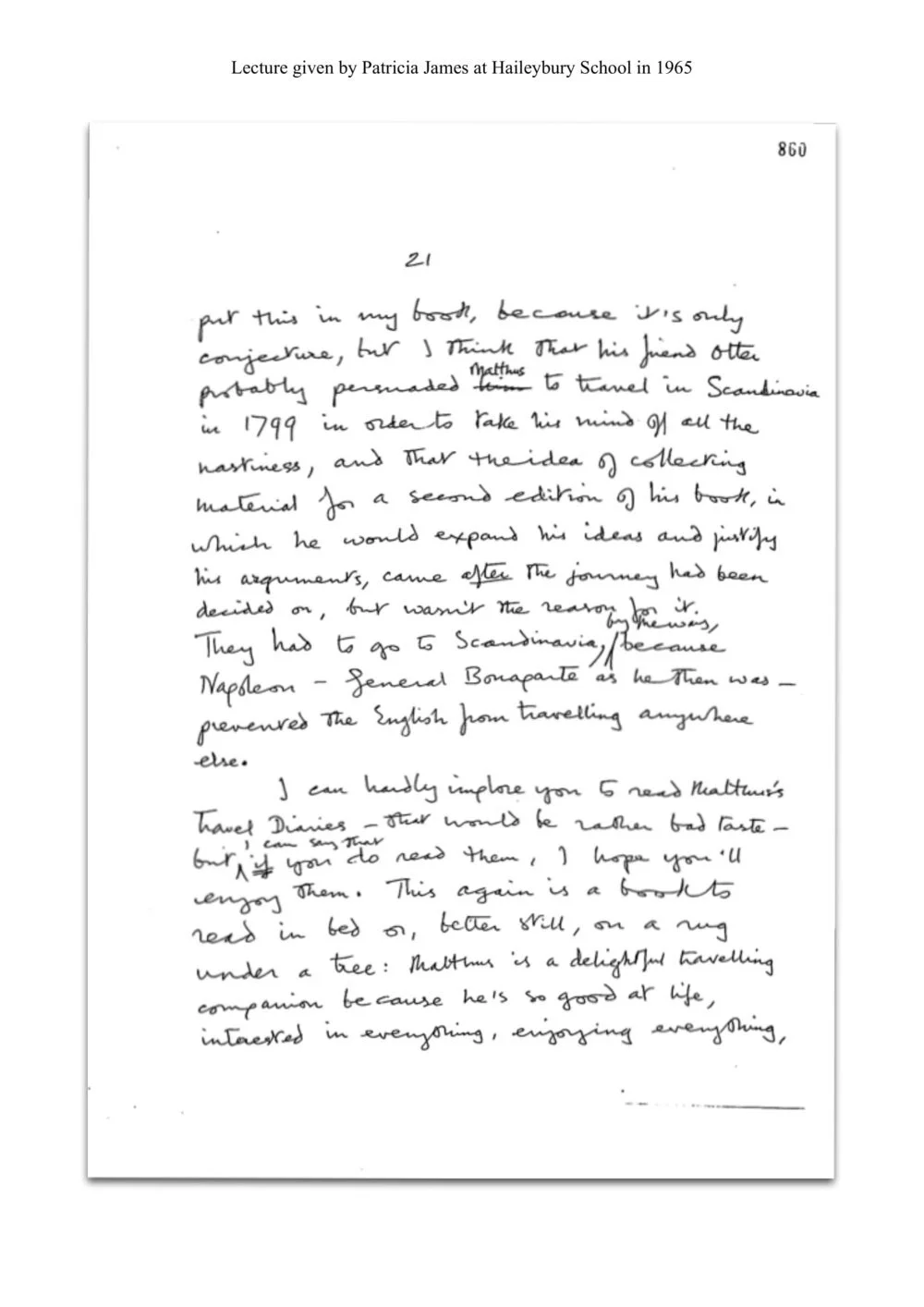
- Well, I don’t want to talk any more about the Essay on Population - do read it for yourselves. You will find it difficult to imagine how such a pleasant, sensible book could have caused what we would now call a stink . But it did, and I’m sure Malthus [did] suffered very much from all the really vile things that were said about him. I haven’t <21> put this in my book, because it’s only conjecture, but I think that his friend Otter probably persuaded Malthus to travel in Scandinavia in 1799 in order to take his mind off all the nastiness, and that the idea of collecting material for a second edition of his book, in which he would expand his ideas and justify his arguments, came after the journey had been decided on, but wasn’t the reason for it. They had to go to Scandinavia, because Napoleon - General Bonaparte as he then was - prevented the English from travelling anywhere else.
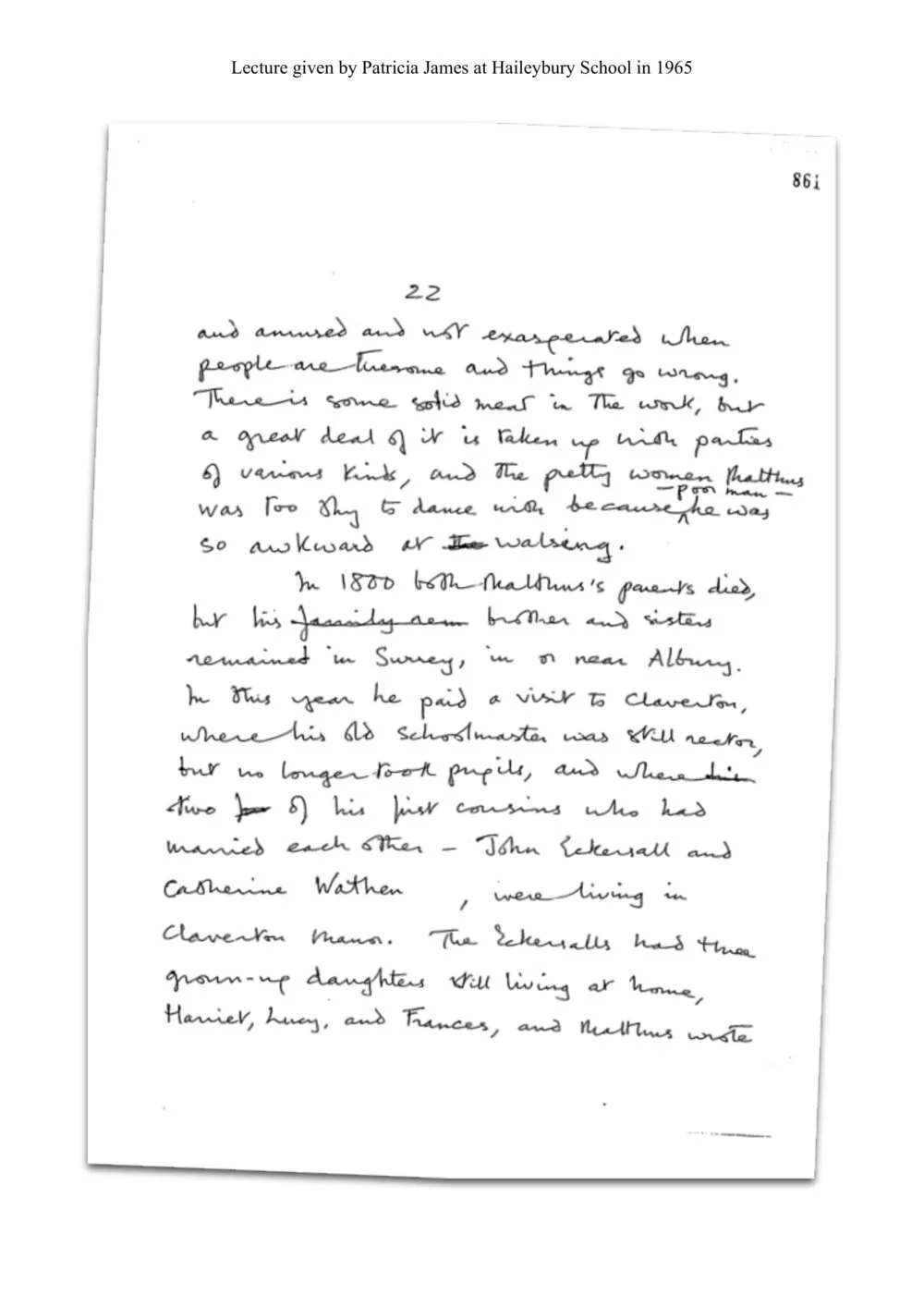
I can hardly implore you to read Malthus’s Travel Diaries - that would be rather bad taste - but I can say that, if you do read them, I hope you’ll enjoy them. This again is a book to read in bed or, better still, on a rug under a tree: Malthus is a delightful travelling companion because he’s so good at life, interested in everything, enjoying everything, <22> and amused and not exasperated when people are tiresome and things are wrong. There is some meat in the work, but a great deal of it is taken up with parties of various kinds, and the pretty women Malthus was too shy to dance with because, poor man, he was so awkward at waltzing.
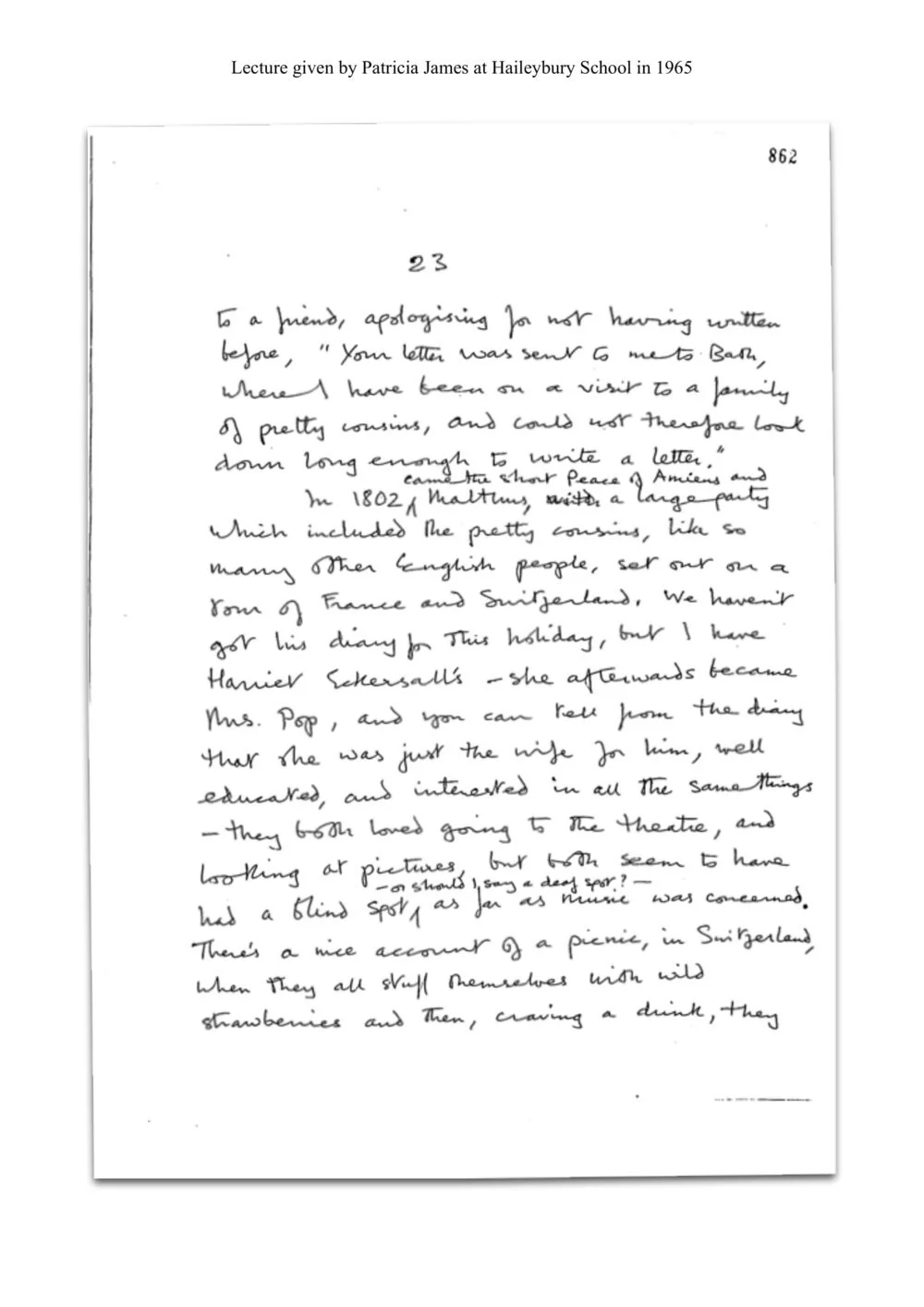
In 1800 both Malthus’s parents died, but his [family] brother and sister remained in Surrey, in or near Albany. In this year he paid a visit to Claverton, where his old schoolmaster was still rector, but no longer took pupils, and where two of his first cousins who had married each other - John Eckersall and Catherine Wathen, were living in Claverton Manor. The Eckersalls had three grown up daughters still living at home, Harriet, Lucy, and Frances, and Malthus wrote <23> to a friend, apologising for not having written before, “your letter was sent to me to Bath, where I have been on a visit to a family of pretty cousins, and could not therefor look down long enough to write a letter.”
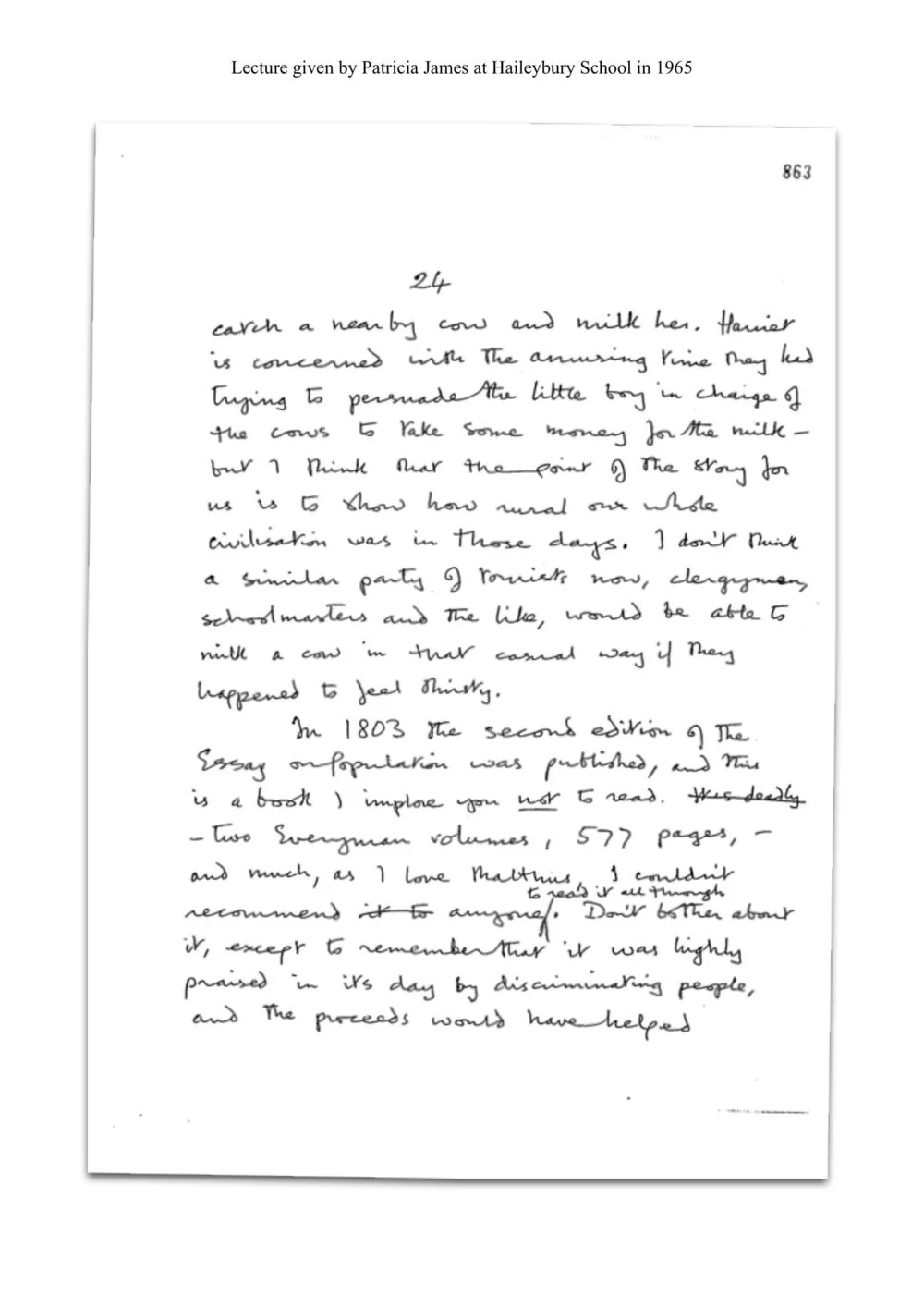
In 1802 came the short peace of Amiens and Malthus, with a large party which included the pretty cousins, like so many other English people, set out on a tour of France and Switzerland, we haven’t got his diary for this holiday, but I have Harriet Eckersall’s - she afterwards became Mrs. Pop, and you can tell from the diary that she was just the wife for him, well educated, and interested in all the same things - they both loved going to the theatre, and looking at pictures, but both seem to have had a blind spot - or should I say a deaf spot? - as far as music was concerned. There’s a nice account of a picnic, in Switzerland, when they all stuff themselves with wild strawberries and then, craving a drink, they <24> catch a nearby cow and milk her. Harriet is concerned with the amusing time they had trying to persuade the little boy in charge of the cows to take some money for the milk - but I think that the point of the story for us is to show how rural our whole civilisation was in those days. I don’t think a similar party of townists, clergymen, schoolmasters and the like, would be able to milk a cow in that casual way if they happened to feel thirsty.
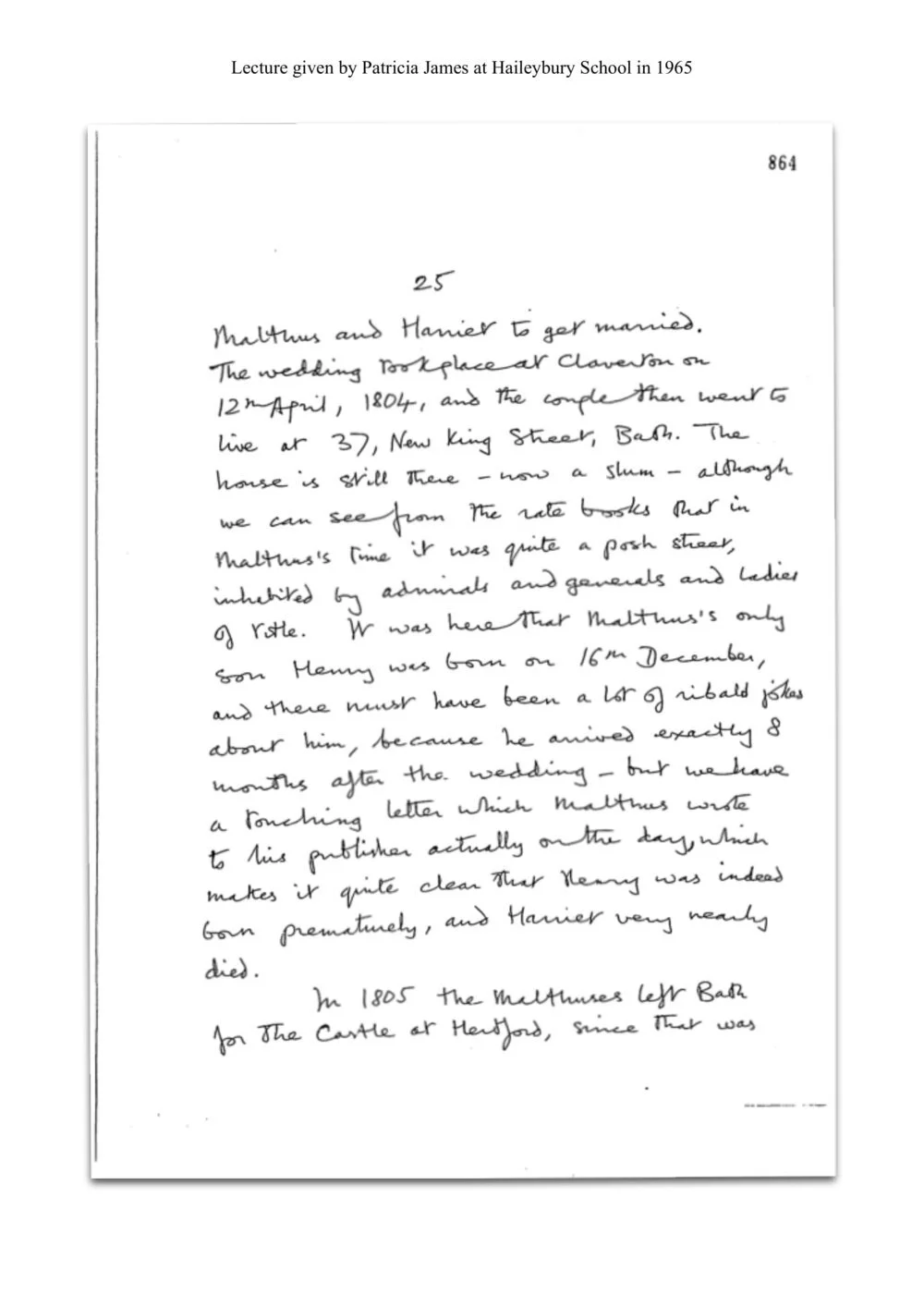
1803 the second edition of the Essay on Population was published, and this is a book I implore you not to read. [It is deadly] - Two everyman volumes, 577 pages, - and much, as I love Malthus, I couldn’t recommend [it to] anyone to read it all through. Don’t bother about it, except to remember that it was highly praised in its day by discriminating people, and the proceeds would have helped <25> Malthus and Harriet to get married.
The wedding took place at Claverton on 12th April, 1804, and the couple then went to live at 37, New King Street, Bath. The house is still there. Now a slum - although we can see from the sale books that in Malthus’s time it was quite a posh street, inhabited by admirals and generals and ladies of taste. It was here that Malthus’s only son Henry was born on 16th December, and there must have been a lot of ribald jokes about him, because he arrived exactly 8 months after the wedding - but we have a touching letter which Malthus wrote to his publisher actually on the day, which makes it quite clear that Henry was indeed born prematurely, and Harriet very nearly died.
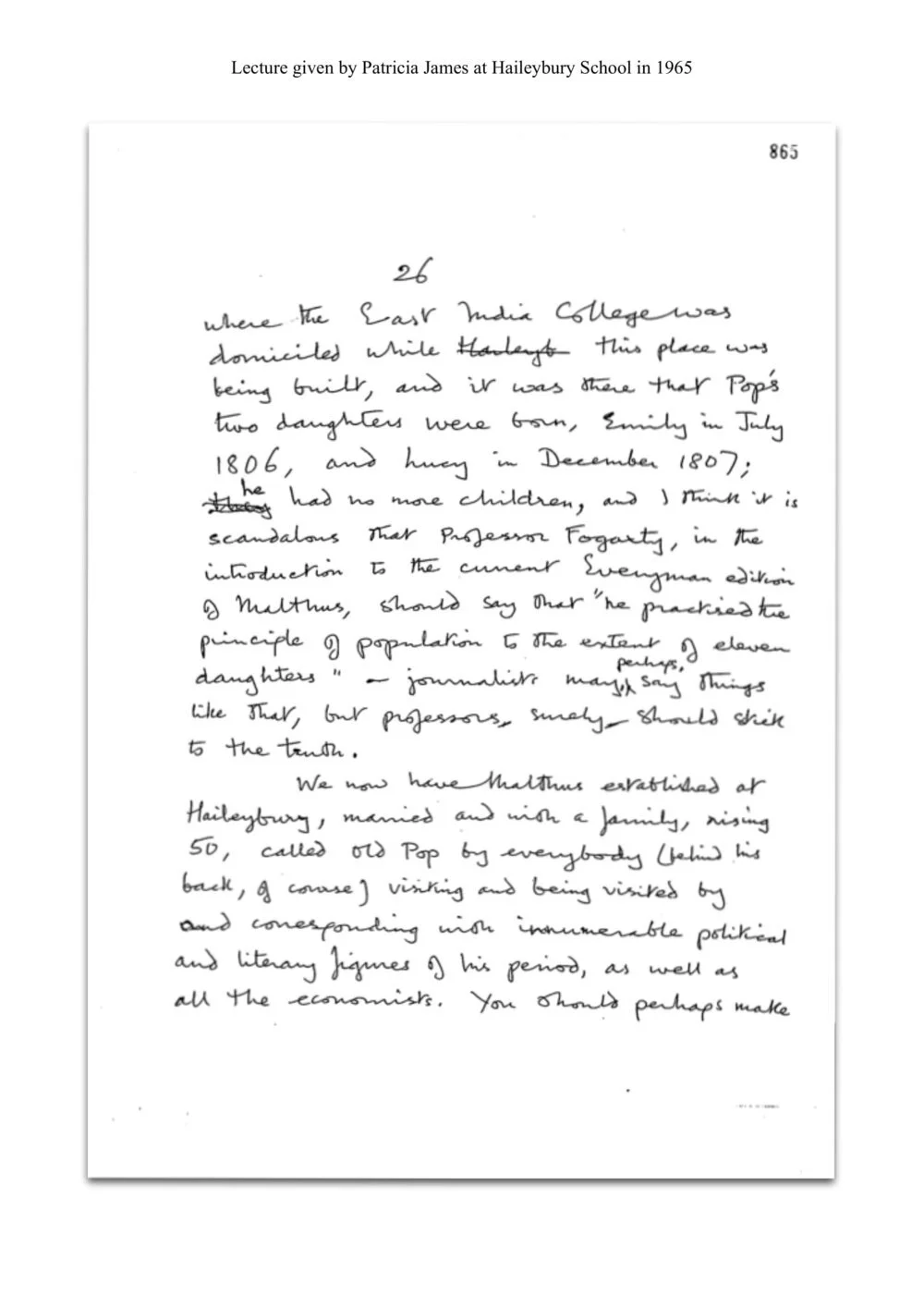
In 1805 the Malthuses left Bath for the Castle at Hertford, since that was <26> where the East India College was domiciled while [Haileybury] this place was being built, and it was there that Pop’s two daughters were born, Emily in July 1806, and Lucy in December 1807; he had no more children, and I think it is scandalous that professor Fogarty, in the introduction to the current Everyman edition of Malthus, should say that “he practiced the principle of population to the extent of eleven daughters” - journalists may perhaps say things like that, but professors, surely, should stick to the truth.
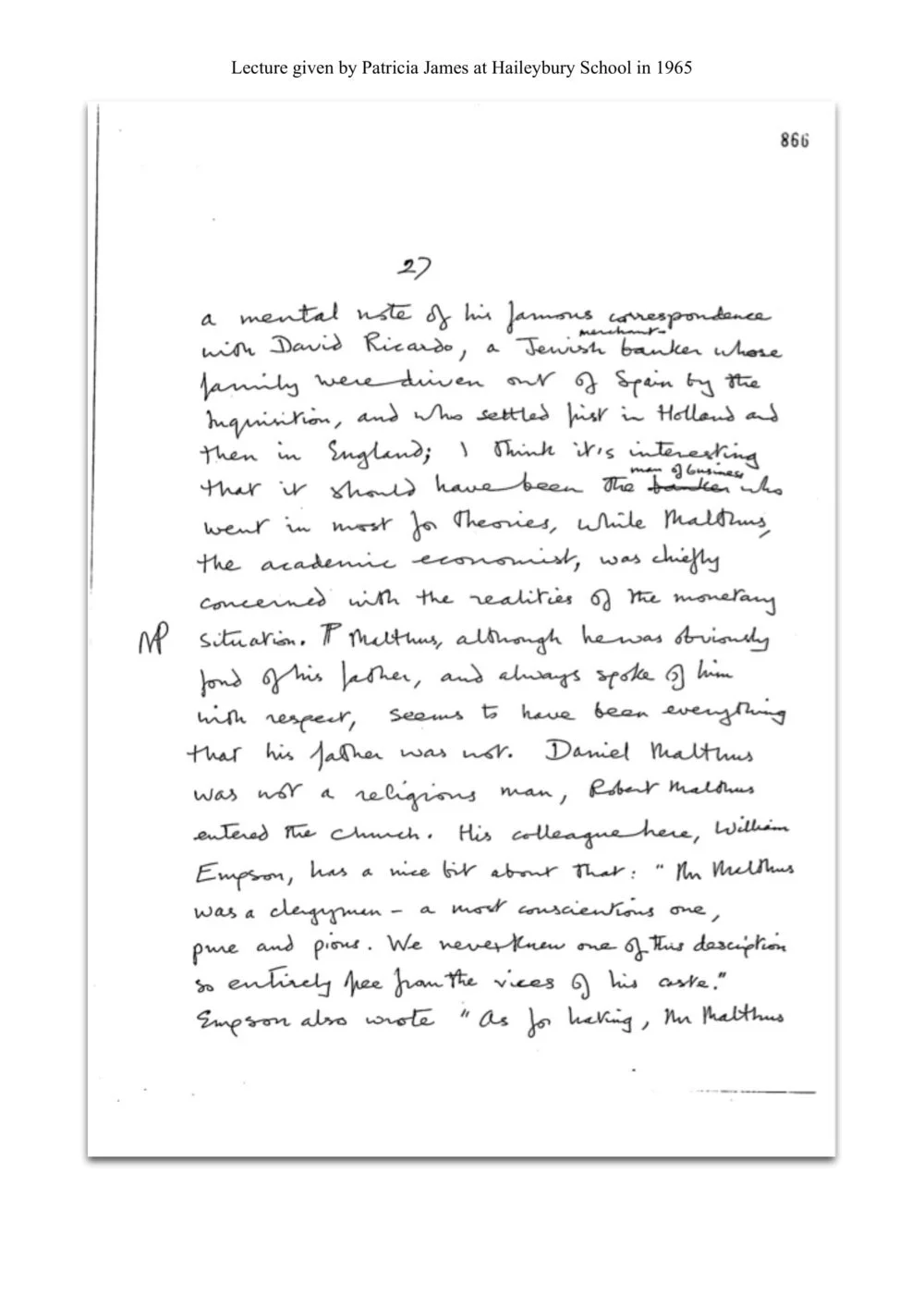
We now have Malthus established at Haileybury, married and with a family, rising 50, called Old Pop by everybody (behind his back, of course), visiting and being visited by and corresponding with innumerable political and literary figures of his period, as well as all the economists. You should perhaps make <27> a mental note of his famous correspondence with David Ricardo, a Jewish banker whose family were driven out of Spain by the Inquisition, and who settled first in Holland and then in England, I think it’s interesting that it should have been the man of business who went in most for theories, while Malthus, the academic economist, was chiefly concerned with the realities of the monetary situation.
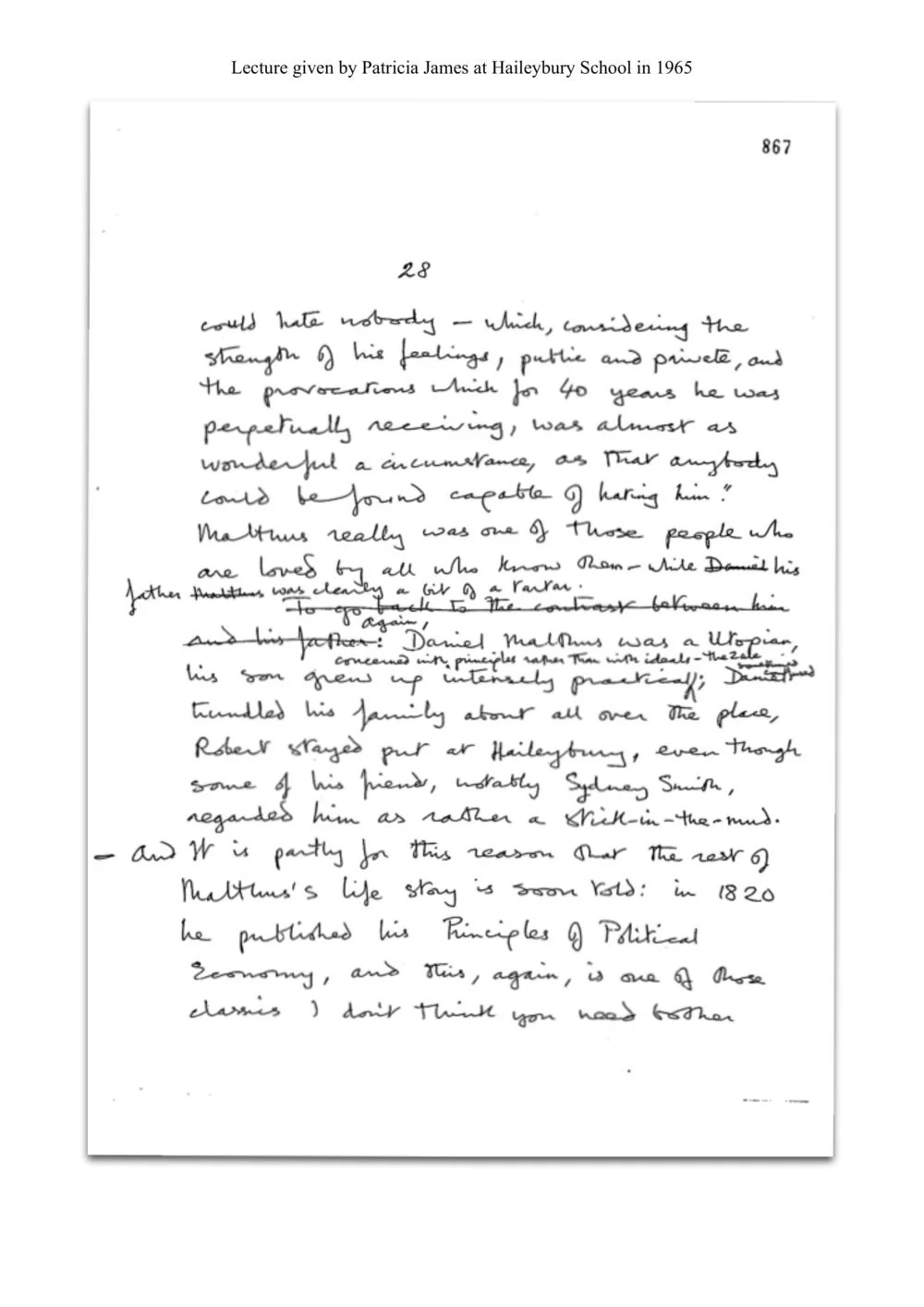
Malthus, although he was obviously fond of his father, and always spoke of him with respect, seems to have been everything that his father was not. Daniel Malthus was not a religious man, Robert Malthus entered the church. His colleague here, William Empson, has a nice bit about that: “Mr Malthus was a clergyman - a most conscientious one, pure and pious. We never knew one of this description so entirely free from the vices of his caste.” Empson also wrote: “As for hating, Mr. Malthus <28> could hate nobody - which, considering the strength of his feelings, public and private, and the provocations which for 40 years he was perpetually receiving, was almost as wonderful a circumstance, as that anybody could be found capable of hating him.” Malthus really was one of those people who are loved by all who know them while [Daniel] his father [Malthus] was clearly a bit of a <rarrar?>.
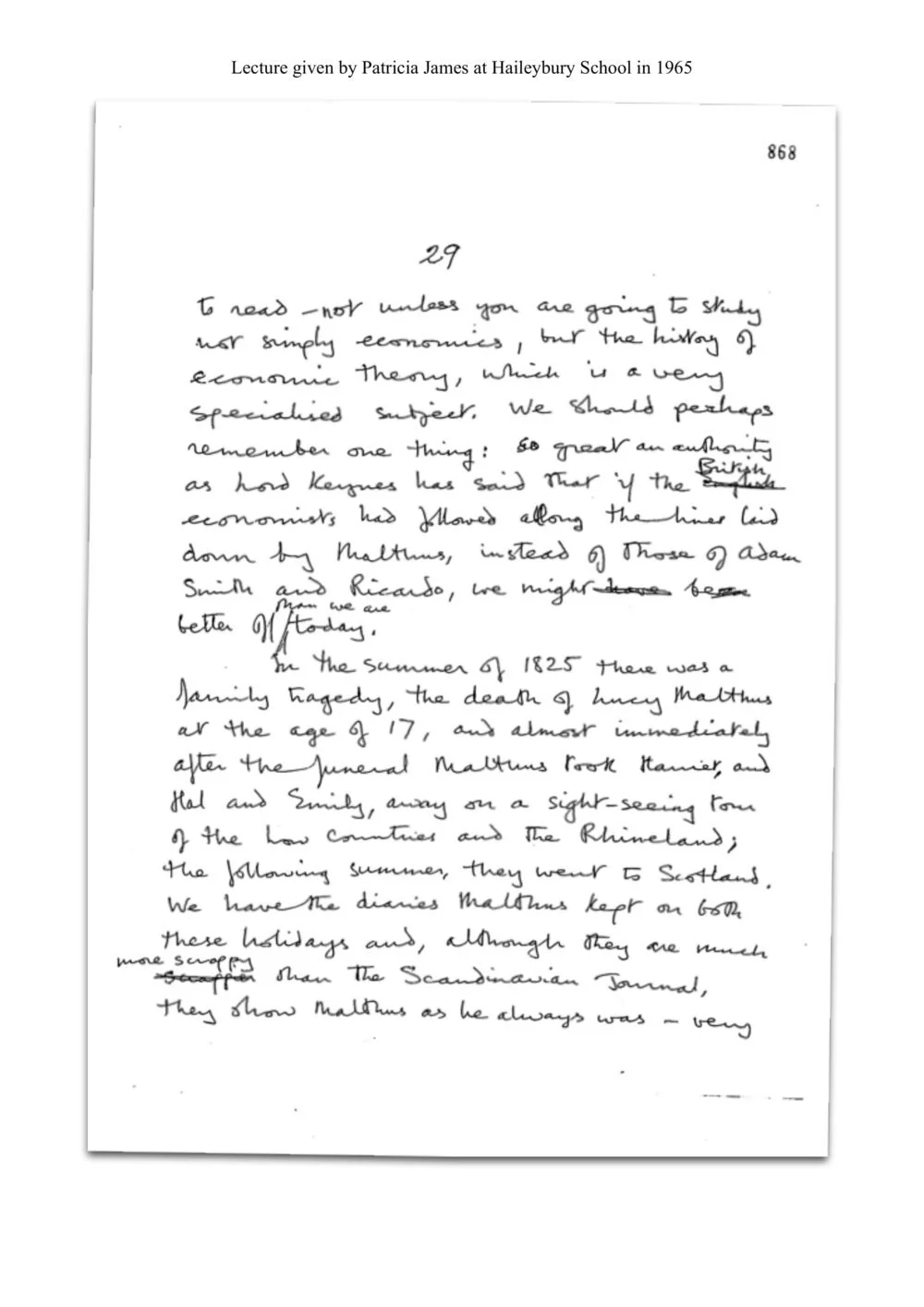
[To go back to the contrast between him and his father:] Again, Daniel Malthus was a Utopian, his son grew up intensely practical, concerned with principles rather than with ideals - <?>. Daniel trundled his family about all over the place, Robert stayed put at Haileybury, even though some of his friends, notably Sydney Smith, regarded him as rather a stick-in-the-mid. And it is partly for this reason that the rest of Malthus’s life story is soon told: in 1820 he published his Principles of Political Economy, and this, again, is one of those classics I don’t think you need bother <29> to read - not unless you are going to study not simply economics, but the history of economic theory, which is a very specialised subject. We should perhaps remember one thing: so great an authority as Lord Keynes has said that if the British economists had followed along the lines laid down by Malthus, instead of those of Adam Smith and Ricardo, we might [have] be better off than we are today.
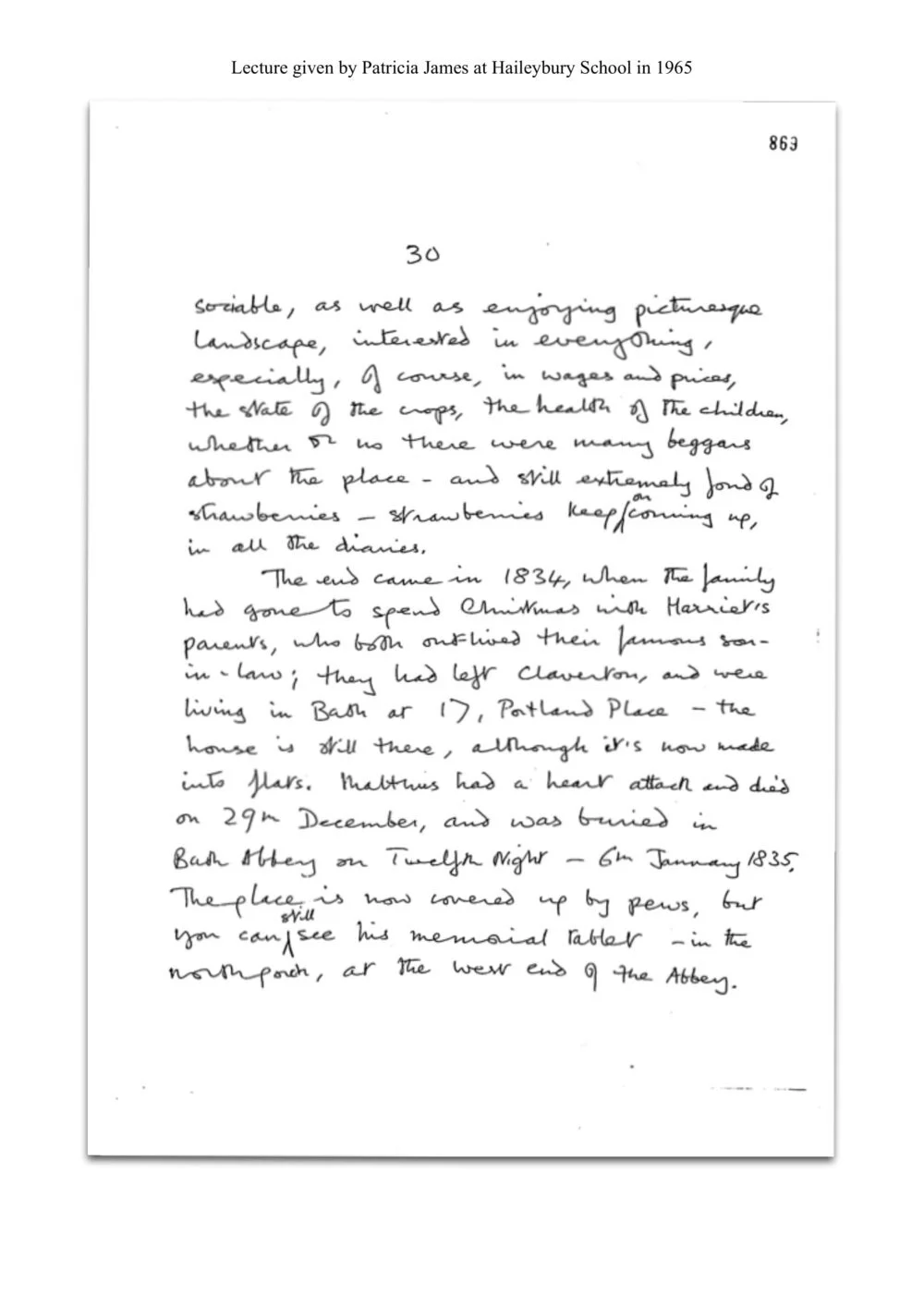
In the summer of 1825 there was a family tragedy, the death of Lucy Malthus at the age of 17, and almost immediately after the funeral Malthus took Harriet, and Hal and Emily, away on a sight-seeing tour of the low countries and the Rhineland; the following summer, they went to Scotland. We have the diaries Malthus kept on both these holidays and, although they are much more scrappy than the Scandinavian Journal, they show Malthus as he always was - very <30> sociable, as well as enjoying picturesque landscape, interested in everything, especially, of course, in wages and prices, the state of the crops, the health of the children, whether or no there were many beggars about the place - and still extremely fond of strawberries - strawberries keep on coming up, in all the diaries.
The end came in 1834, when the family had gone to spend Christmas with Harriet’s parents, who both out-lived their famous son-in-law; they had left Claverton, and were living in Bath at 17, Portland Place - the house is still there, although it’s now made into flats. Malthus had a heart attack and died on 29th December, and was buried in Bath Abbey on Twelfth Night - 6th January 1835. The place is now covered up by pews, but you can still see his memorial tablet - in the north porch, at the west end of the Abbey.
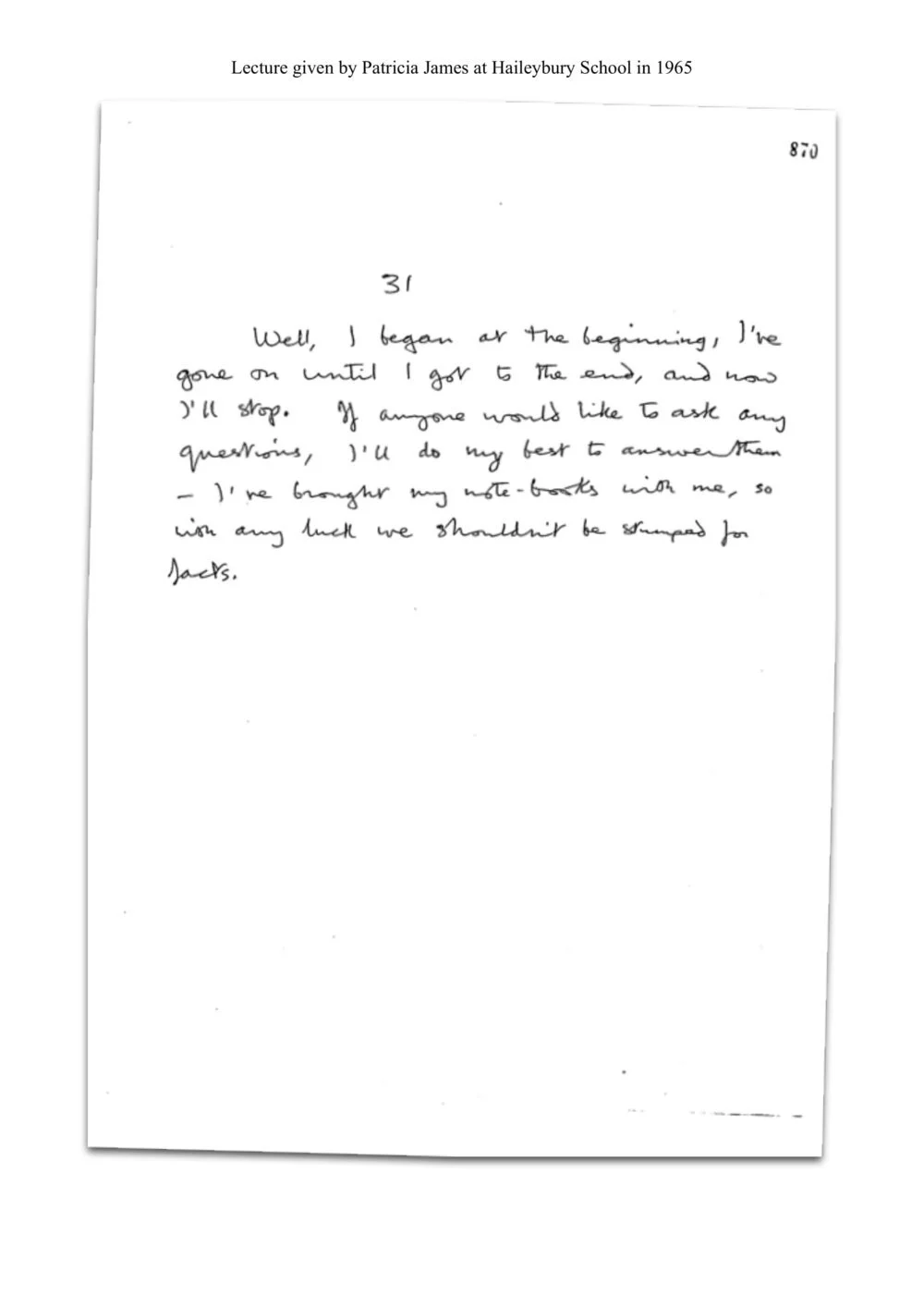
<31> Well, I began at the beginning, I’ve gone on until I got to the end, and now I’ll stop. If anyone would like to ask any questions, I’ll do my best to answer them - I’ve brought my note-books with me, so with any luck we shouldn’t be stumped for facts. goes here